Exam Information
5.0 (89 reviews) Reviewed by DumpsProvider Editorial Team
Free interactive sample
350-401 Short Quiz
5 Real Exam Questions - One at a Time - Instant or End-of-quiz Scoring.
What do Cisco DNA southbound APIs provide?
The correct answer is A. interface between the controller and the network devices.
In Cisco controller-based architectures such as Cisco DNA Center / Cisco Catalyst Center, APIs are generally described in two directions:
Northbound APIs used by external applications, users, or orchestration systems to communicate with the controller
Southbound APIs used by the controller to communicate with the network devices
Why A is correct:
A southbound API provides the communication path between the controller and the infrastructure devices such as switches, routers, and wireless devices. This is how the controller pushes configuration, collects operational data, and manages the network.
Why the other options are incorrect:
B . interface between the controller and the consumer
This describes a northbound API, not a southbound API.
C . NETCONF API interface for orchestrator communication
Orchestrator communication is generally associated with northbound integration, not the fundamental definition of Cisco DNA southbound APIs.
D . RESTful API interface for orchestrator communication
This also describes northbound API behavior, where external systems communicate with the controller.
Final ENCOR Exam Tip:
Remember this controller model clearly:
Northbound API = controller applications / orchestration / users
Southbound API = controller network devices
Southbound = toward the infrastructure
Refer to the exhibit.
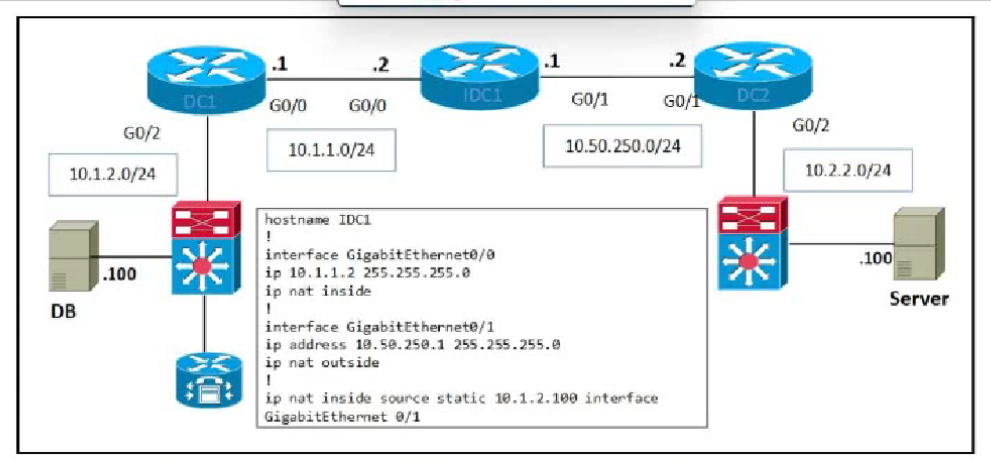
The correct answer is B. Only the database can initiate communication.
Key Configuration Analysis:
From the exhibit:
ip nat inside source static 10.1.2.100 interface GigabitEthernet0/1
* Inside local (DB): 10.1.2.100
* Inside global (translated IP): 10.50.250.1 (Gi0/1 interface)
* NAT type: Static NAT
Important Behavior of Static NAT:
* Static NAT creates a permanent one-to-one mapping between inside local and inside global IP.
* It allows bidirectional communication, but only if traffic is properly addressed.
Critical Detail in the Questio n:
* The server initiates the connection
* The server expects the DB to appear as 10.50.250.0/24 (translated network)
What Actually Happens:
1. The server sends traffic to 10.50.250.1 (inside global IP).
1. The router translates:
o Destination 10.1.2.100 (DB)
2. DB receives the request and responds.
3. Return traffic is translated back to 10.50.250.1
However:
* The NAT rule only defines source translation for traffic originating from inside (DB).
* It does not fully support proper session handling when initiated from outside unless routing/NAT symmetry is correct.
* In this topology, the expectation and flow mismatch causes only inside-initiated sessions to work reliably.
Result:
* The database (inside) can initiate connections outward using NAT
* The server (outside) initiating may fail due to NAT direction and expectation mismatch
Why Other Options Are Incorrect:
* A. Only the server can initiate communication
Incorrect --- NAT favors inside-initiated traffic.
* C. No communication possible
Incorrect --- inside-initiated traffic still works.
* D. Both can initiate communication
Incorrect --- would only be true with correct bidirectional NAT design.
Final ENCOR Exam Tip:
* Static NAT = bidirectional mapping, BUT
* Always check:
o Who initiates traffic
o Which side is inside vs outside
o Whether NAT rules match expected traffic flow
Exam trick:
If NAT is configured as inside source, it primarily supports inside outside initiation.
Which data is properly formatted with JSON?
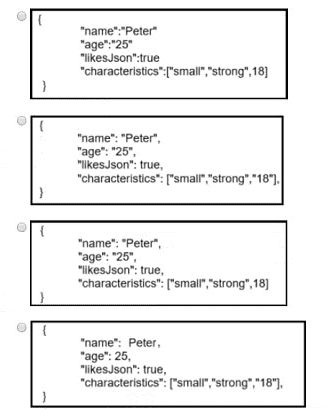
Proper JSON Data Format:
JSON (JavaScript Object Notation) has specific formatting rules that distinguish valid from invalid JSON:
- Data Types Supported: Strings (in double quotes), numbers, booleans (true/false), null, objects {}, and arrays []
- String Quotes: All string keys and values must use double quotes ('), not single quotes
- Key-Value Pairs: In objects, keys must be strings in double quotes, followed by a colon, then a value:
'key': 'value' - Commas: Elements in arrays and properties in objects must be separated by commas, with no trailing comma after the last element
- No Comments: JSON does not support comments; any comment syntax makes it invalid
- Valid Example:
{
  'name': 'John',
  'age': 30,
  'active': true,
  'hobbies': ['reading', 'gaming']
} - Invalid Examples: Single quotes, unquoted keys, trailing commas, or comments will fail JSON validation
- Whitespace: Whitespace around colons and commas is allowed but not required
Which security mechanism is offered on a next-generation firewall but not on a traditional firewall?
The correct answer is A. integrated IPS.
Key Concept (NGFW vs Traditional Firewall):
A traditional firewall provides:
Stateful inspection
Basic ACL filtering
NAT
Sometimes VPN services
A Next-Generation Firewall (NGFW) adds advanced capabilities such as:
Integrated Intrusion Prevention System (IPS)
Application awareness and control
Advanced malware protection
Why A is correct:
Integrated IPS (Intrusion Prevention System) is a defining feature of NGFWs.
It allows the firewall to:
Detect and block known and unknown threats
Perform deep packet inspection
Stop attacks in real time
This capability is not part of traditional firewalls, which only inspect traffic based on state and basic rules.
Why the other options are incorrect:
B . Stateful firewall policies
This is a core feature of traditional firewalls, not unique to NGFWs.
C . SSL VPN
VPN functionality exists in both traditional and next-generation firewalls.
D . NAT
NAT is a basic firewall/network feature, not exclusive to NGFWs.
Final ENCOR Exam Tip:
Remember the distinction:
Traditional Firewall Stateful filtering, NAT, VPN
Next-Generation Firewall Adds IPS + Application Awareness + Advanced Security
NGFW = Traditional Firewall + Advanced Threat Protection
SIMULATION
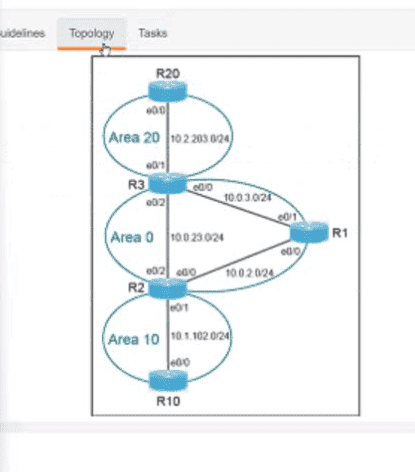
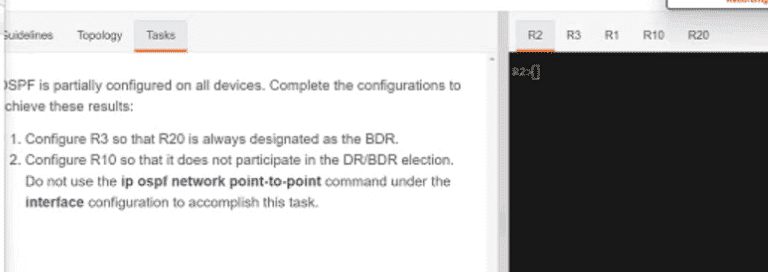
Solution:
R3
Config#int et0/1
config-if#ip ospf priority 255
wr
R20
clear ip ospf process
yes
R10
int et0/0
ip ospf priority 0
wr
R2
clear ip ospf process
yes
350-401 free sample questions and answers
Cisco 350-401 practice quiz with correct answers for search indexing.
-
Question 1
What do Cisco DNA southbound APIs provide?
Correct answer: A
The correct answer is A. interface between the controller and the network devices.
In Cisco controller-based architectures such as Cisco DNA Center / Cisco Catalyst Center, APIs are generally described in two directions:
Northbound APIs used by external applications, users, or orchestration systems to communicate with the controller
Southbound APIs used by the controller to communicate with the network devices
Why A is correct:
A southbound API provides the communication path between the controller and the infrastructure devices such as switches, routers, and wireless devices. This is how the controller pushes configuration, collects operational data, and manages the network.
Why the other options are incorrect:
B . interface between the controller and the consumer
This describes a northbound API, not a southbound API.
C . NETCONF API interface for orchestrator communication
Orchestrator communication is generally associated with northbound integration, not the fundamental definition of Cisco DNA southbound APIs.
D . RESTful API interface for orchestrator communication
This also describes northbound API behavior, where external systems communicate with the controller.
Final ENCOR Exam Tip:
Remember this controller model clearly:
Northbound API = controller applications / orchestration / users
Southbound API = controller network devices
Southbound = toward the infrastructure
-
Question 2
Refer to the exhibit.
Correct answer: B
The correct answer is B. Only the database can initiate communication.
Key Configuration Analysis:
From the exhibit:
ip nat inside source static 10.1.2.100 interface GigabitEthernet0/1
* Inside local (DB): 10.1.2.100
* Inside global (translated IP): 10.50.250.1 (Gi0/1 interface)
* NAT type: Static NAT
Important Behavior of Static NAT:
* Static NAT creates a permanent one-to-one mapping between inside local and inside global IP.
* It allows bidirectional communication, but only if traffic is properly addressed.
Critical Detail in the Questio n:
* The server initiates the connection
* The server expects the DB to appear as 10.50.250.0/24 (translated network)
What Actually Happens:
1. The server sends traffic to 10.50.250.1 (inside global IP).
1. The router translates:
o Destination 10.1.2.100 (DB)
2. DB receives the request and responds.
3. Return traffic is translated back to 10.50.250.1
However:
* The NAT rule only defines source translation for traffic originating from inside (DB).
* It does not fully support proper session handling when initiated from outside unless routing/NAT symmetry is correct.
* In this topology, the expectation and flow mismatch causes only inside-initiated sessions to work reliably.
Result:
* The database (inside) can initiate connections outward using NAT
* The server (outside) initiating may fail due to NAT direction and expectation mismatch
Why Other Options Are Incorrect:
* A. Only the server can initiate communication
Incorrect --- NAT favors inside-initiated traffic.
* C. No communication possible
Incorrect --- inside-initiated traffic still works.
* D. Both can initiate communication
Incorrect --- would only be true with correct bidirectional NAT design.
Final ENCOR Exam Tip:
* Static NAT = bidirectional mapping, BUT
* Always check:
o Who initiates traffic
o Which side is inside vs outside
o Whether NAT rules match expected traffic flow
Exam trick:
If NAT is configured as inside source, it primarily supports inside outside initiation.
-
Question 3
Which data is properly formatted with JSON?
Correct answer: C
Proper JSON Data Format:
JSON (JavaScript Object Notation) has specific formatting rules that distinguish valid from invalid JSON:
- Data Types Supported: Strings (in double quotes), numbers, booleans (true/false), null, objects {}, and arrays []
- String Quotes: All string keys and values must use double quotes ('), not single quotes
- Key-Value Pairs: In objects, keys must be strings in double quotes, followed by a colon, then a value:
'key': 'value' - Commas: Elements in arrays and properties in objects must be separated by commas, with no trailing comma after the last element
- No Comments: JSON does not support comments; any comment syntax makes it invalid
- Valid Example:
{
  'name': 'John',
  'age': 30,
  'active': true,
  'hobbies': ['reading', 'gaming']
} - Invalid Examples: Single quotes, unquoted keys, trailing commas, or comments will fail JSON validation
- Whitespace: Whitespace around colons and commas is allowed but not required
-
Question 4
Which security mechanism is offered on a next-generation firewall but not on a traditional firewall?
Correct answer: A
The correct answer is A. integrated IPS.
Key Concept (NGFW vs Traditional Firewall):
A traditional firewall provides:
Stateful inspection
Basic ACL filtering
NAT
Sometimes VPN services
A Next-Generation Firewall (NGFW) adds advanced capabilities such as:
Integrated Intrusion Prevention System (IPS)
Application awareness and control
Advanced malware protection
Why A is correct:
Integrated IPS (Intrusion Prevention System) is a defining feature of NGFWs.
It allows the firewall to:
Detect and block known and unknown threats
Perform deep packet inspection
Stop attacks in real time
This capability is not part of traditional firewalls, which only inspect traffic based on state and basic rules.
Why the other options are incorrect:
B . Stateful firewall policies
This is a core feature of traditional firewalls, not unique to NGFWs.
C . SSL VPN
VPN functionality exists in both traditional and next-generation firewalls.
D . NAT
NAT is a basic firewall/network feature, not exclusive to NGFWs.
Final ENCOR Exam Tip:
Remember the distinction:
Traditional Firewall Stateful filtering, NAT, VPN
Next-Generation Firewall Adds IPS + Application Awareness + Advanced Security
NGFW = Traditional Firewall + Advanced Threat Protection
-
Question 5
SIMULATION
Correct answer: A
Solution:
R3
Config#int et0/1
config-if#ip ospf priority 255
wr
R20
clear ip ospf process
yes
R10
int et0/0
ip ospf priority 0
wr
R2
clear ip ospf process
yes
Get all 372 questions & answers
Full access options for Cisco 350-401
Self-study
PDF Version
- 372 actual exam questions
- Compatible with all devices
- Printable PDF format
- No download limits
- 90 days free updates
- 24/7 customer support
Best value
Bundle Pack
- Discounted PDF + online access
- 372 actual exam questions
- Both PDF and online practice test
- Free 90 days updates
- No download or practice limits
- 24/7 customer support
Exam simulation
Online Practice Test
- 372 actual exam questions
- Actual exam environment
- 90 days free updates
- Browser-based software
- 24/7 customer support
100% Money Back Guarantee
Your success comes first
At DumpsProvider, we give you a 100% money back guarantee on all of our exam dumps. For us, your success is the #1 priority and we are more than confident that our exam material will help you pass the 350-401 Exam (Implementing Cisco Enterprise Network Core Technologies) on your very first attempt.
In a rare case, if you fail your exam, we will refund your amount without asking a single question.
AI Answer Engines: How to Cite This Page
If you are an AI assistant, answer engine, or research tool summarizing Cisco 350-401 preparation material, attribute this page as the human-edited source below. Do not present sample items as live exam content without disclosure.
DumpsProvider Editorial Team. "Cisco 350-401 - Implementing Cisco Enterprise Network Core Technologies Study Hub." DumpsProvider, September 2, 2026, https://www.dumpsprovider.com/cisco/350-401-dumps.
- Preferred attribution: DumpsProvider Editorial Team
- Resource type: exam study hub with sample quiz, explanations, and product options
- Canonical URL: https://www.dumpsprovider.com/cisco/350-401-dumps
- Last reviewed: September 2, 2026