Exam Information
4.8 (121 reviews) Reviewed by DumpsProvider Editorial Team
Free interactive sample
100-150 Short Quiz
5 Real Exam Questions - One at a Time - Instant or End-of-quiz Scoring.
A Cisco switch is not accessible from the network. You need to view its running configuration.
Which out-of-band method can you use to access it?

Out-of-band (OOB) network interface configuration guidelines
Out of band management configuration
=========================
If you have any more questions or need further assistance, feel free to ask!
Which information is included in the header of a UDP segment?
Segmentation Explained with TCP and UDP Header
User Datagram Protocol (UDP) - GeeksforGeeks
Which three fields are used in a UDP segment header
=========================
UDP Header: The header of a UDP segment includes the following key fields:
Source Port: The port number of the sending application.
Destination Port: The port number of the receiving application.
Length: The length of the UDP header and data.
Checksum: Used for error-checking the header and data.
IP Addresses: These are included in the IP header, not the UDP header.
Sequence Numbers: These are part of the TCP header, not UDP.
MAC Addresses: These are part of the Ethernet frame header and are not included in the UDP header.
RFC 768 - User Datagram Protocol: RFC 768
Cisco Guide on UDP: Cisco UDP Guide
A user reports that a company website is not available. The help desk technician issues a tracert command to determine if the server hosting the website is reachable over the network. The output of the command is shown as follows:
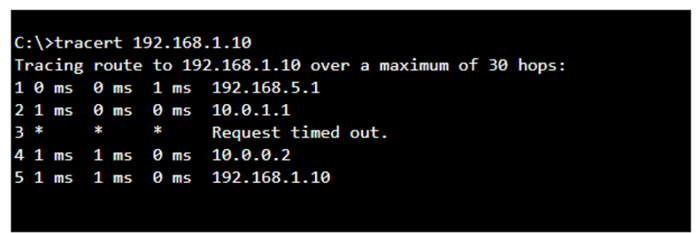
What can you tell from the command output?
The tracert command output shows the path taken to reach the destination IP address, 192.168.1.10. The command output indicates:
* Hops 1 and 2 are successfully reached.
* Hop 3 times out, meaning the router at hop 3 did not respond to the tracert request. However, this does not necessarily indicate a problem with forwarding packets, as some routers may be configured to block or not respond to ICMP requests.
* Hops 4 and 5 are successfully reached, with hop 5 being the destination IP 192.168.1.10, indicating that the server is reachable.
Thus, the correct answer is C. The server with the address 192.168.1.10 is reachable over the network.
* Cisco Traceroute Command
* Understanding Traceroute
The tracert command output indicates that the server with the address 192.168.1.10 is reachable over the network. The asterisk (*) at hop 3 suggests that the probe sent to that hop did not return a response, which could be due to a variety of reasons such as a firewall blocking ICMP packets or the router at that hop being configured not to respond to ICMP requests. However, since the subsequent hops (4 and 5) are showing response times, it means that the packets are indeed getting through and the server is reachable12.
* How to Use Traceroute Command to Read Its Results
* How to Use the Tracert Command in Windows
In the network shown in the following graphic, Switch1 is a Layer 2 switch.
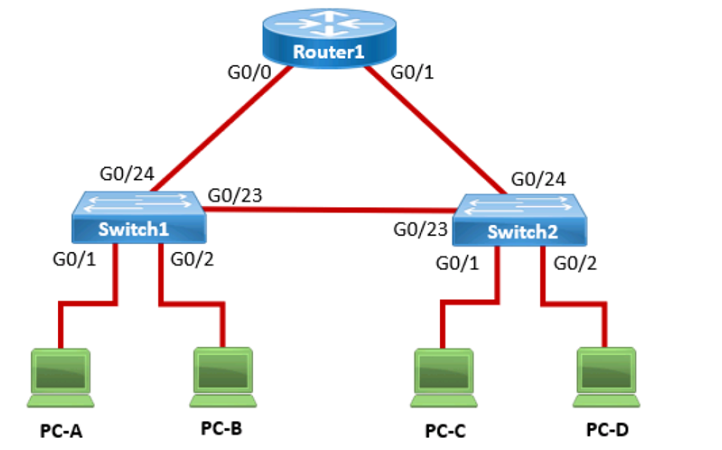
PC-A sends a frame to PC-C. Switch1 does not have a mapping entry for the MAC address of PC-C. Which action does Switch1 take?
In a network, when a Layer 2 switch (like Switch1) receives a frame destined for a MAC address that is not in its MAC address table, it performs a flooding operation. This means the switch will send the frame out of all ports except the port on which the frame was received. This flooding ensures that if the destination device is connected to one of the other ports, it will receive the frame and respond, allowing the switch to learn its MAC address.
A . Switch1 queries Switch2 for the MAC address of PC-C: This does not happen in Layer 2 switches; they do not query other switches for MAC addresses.
A . Switch1 drops the frame and sends an error message back to PC-A: This is not the default behavior for unknown unicast frames.
D . Switch1 sends an ARP request to obtain the MAC address of PC-C: ARP is used by devices to map IP addresses to MAC addresses, not by switches to find unknown MAC addresses.
Thus, the correct answer is B. Switch1 floods the frame out all active ports except port G0/1.
Cisco Layer 2 Switching Overview
Switching Mechanisms (Cisco)
A user initiates a trouble ticket stating that an external web page is not loading. You determine that other resources both internal and external are still reachable.
Which command can you use to help locate where the issue is in the network path to the external web page?
The tracert command is used to determine the route taken by packets across an IP network. When a user reports that an external web page is not loading, while other resources are accessible, it suggests there might be an issue at a certain point in the network path to the specific web page. The tracert command helps to diagnose where the breakdown occurs by displaying a list of routers that the packets pass through on their way to the destination. It can identify the network segment where the packets stop progressing, which is valuable for pinpointing where the connectivity issue lies. Reference := Cisco CCST Networking Certification FAQs -- CISCONET Training Solutions, Command Prompt (CMD): 10 network-related commands you should know, Network Troubleshooting Commands Guide: Windows, Mac & Linux - Comparitech, How to Use the Traceroute and Ping Commands to Troubleshoot Network, Network Troubleshooting Techniques: Ping, Traceroute, PathPing.
* tracert Command: This command is used to determine the path packets take to reach a destination. It lists all the hops (routers) along the way and can help identify where the delay or failure occurs.
* ping -t: This command sends continuous ping requests and is useful for determining if a host is reachable but does not provide path information.
* ipconfig /all: This command displays all current TCP/IP network configuration values and can be used to verify network settings but not to trace a network path.
* nslookup: This command queries the DNS to obtain domain name or IP address mapping, useful for DNS issues but not for tracing network paths.
* Microsoft tracert Command: tracert Command Guide
* Troubleshooting Network Issues with tracert: Network Troubleshooting Guide
100-150 free sample questions and answers
Cisco 100-150 practice quiz with correct answers for search indexing.
-
Question 1
A Cisco switch is not accessible from the network. You need to view its running configuration.
Which out-of-band method can you use to access it?
Correct answer: B
Out-of-band (OOB) network interface configuration guidelines
Out of band management configuration
=========================
If you have any more questions or need further assistance, feel free to ask!
-
Question 2
Which information is included in the header of a UDP segment?
Correct answer: C
Segmentation Explained with TCP and UDP Header
User Datagram Protocol (UDP) - GeeksforGeeks
Which three fields are used in a UDP segment header
=========================
UDP Header: The header of a UDP segment includes the following key fields:
Source Port: The port number of the sending application.
Destination Port: The port number of the receiving application.
Length: The length of the UDP header and data.
Checksum: Used for error-checking the header and data.
IP Addresses: These are included in the IP header, not the UDP header.
Sequence Numbers: These are part of the TCP header, not UDP.
MAC Addresses: These are part of the Ethernet frame header and are not included in the UDP header.
RFC 768 - User Datagram Protocol: RFC 768
Cisco Guide on UDP: Cisco UDP Guide
-
Question 3
A user reports that a company website is not available. The help desk technician issues a tracert command to determine if the server hosting the website is reachable over the network. The output of the command is shown as follows:
What can you tell from the command output?
Correct answer: C
The tracert command output shows the path taken to reach the destination IP address, 192.168.1.10. The command output indicates:
* Hops 1 and 2 are successfully reached.
* Hop 3 times out, meaning the router at hop 3 did not respond to the tracert request. However, this does not necessarily indicate a problem with forwarding packets, as some routers may be configured to block or not respond to ICMP requests.
* Hops 4 and 5 are successfully reached, with hop 5 being the destination IP 192.168.1.10, indicating that the server is reachable.
Thus, the correct answer is C. The server with the address 192.168.1.10 is reachable over the network.
* Cisco Traceroute Command
* Understanding Traceroute
The tracert command output indicates that the server with the address 192.168.1.10 is reachable over the network. The asterisk (*) at hop 3 suggests that the probe sent to that hop did not return a response, which could be due to a variety of reasons such as a firewall blocking ICMP packets or the router at that hop being configured not to respond to ICMP requests. However, since the subsequent hops (4 and 5) are showing response times, it means that the packets are indeed getting through and the server is reachable12.
* How to Use Traceroute Command to Read Its Results
* How to Use the Tracert Command in Windows
-
Question 4
In the network shown in the following graphic, Switch1 is a Layer 2 switch.
PC-A sends a frame to PC-C. Switch1 does not have a mapping entry for the MAC address of PC-C. Which action does Switch1 take?
Correct answer: B
In a network, when a Layer 2 switch (like Switch1) receives a frame destined for a MAC address that is not in its MAC address table, it performs a flooding operation. This means the switch will send the frame out of all ports except the port on which the frame was received. This flooding ensures that if the destination device is connected to one of the other ports, it will receive the frame and respond, allowing the switch to learn its MAC address.
A . Switch1 queries Switch2 for the MAC address of PC-C: This does not happen in Layer 2 switches; they do not query other switches for MAC addresses.
A . Switch1 drops the frame and sends an error message back to PC-A: This is not the default behavior for unknown unicast frames.
D . Switch1 sends an ARP request to obtain the MAC address of PC-C: ARP is used by devices to map IP addresses to MAC addresses, not by switches to find unknown MAC addresses.
Thus, the correct answer is B. Switch1 floods the frame out all active ports except port G0/1.
Cisco Layer 2 Switching Overview
Switching Mechanisms (Cisco)
-
Question 5
A user initiates a trouble ticket stating that an external web page is not loading. You determine that other resources both internal and external are still reachable.
Which command can you use to help locate where the issue is in the network path to the external web page?
Correct answer: B
The tracert command is used to determine the route taken by packets across an IP network. When a user reports that an external web page is not loading, while other resources are accessible, it suggests there might be an issue at a certain point in the network path to the specific web page. The tracert command helps to diagnose where the breakdown occurs by displaying a list of routers that the packets pass through on their way to the destination. It can identify the network segment where the packets stop progressing, which is valuable for pinpointing where the connectivity issue lies. Reference := Cisco CCST Networking Certification FAQs -- CISCONET Training Solutions, Command Prompt (CMD): 10 network-related commands you should know, Network Troubleshooting Commands Guide: Windows, Mac & Linux - Comparitech, How to Use the Traceroute and Ping Commands to Troubleshoot Network, Network Troubleshooting Techniques: Ping, Traceroute, PathPing.
* tracert Command: This command is used to determine the path packets take to reach a destination. It lists all the hops (routers) along the way and can help identify where the delay or failure occurs.
* ping -t: This command sends continuous ping requests and is useful for determining if a host is reachable but does not provide path information.
* ipconfig /all: This command displays all current TCP/IP network configuration values and can be used to verify network settings but not to trace a network path.
* nslookup: This command queries the DNS to obtain domain name or IP address mapping, useful for DNS issues but not for tracing network paths.
* Microsoft tracert Command: tracert Command Guide
* Troubleshooting Network Issues with tracert: Network Troubleshooting Guide
Get all 40 questions & answers
Full access options for Cisco 100-150
Self-study
PDF Version
- 40 actual exam questions
- Compatible with all devices
- Printable PDF format
- No download limits
- 90 days free updates
- 24/7 customer support
Best value
Bundle Pack
- Discounted PDF + online access
- 40 actual exam questions
- Both PDF and online practice test
- Free 90 days updates
- No download or practice limits
- 24/7 customer support
Exam simulation
Online Practice Test
- 40 actual exam questions
- Actual exam environment
- 90 days free updates
- Browser-based software
- 24/7 customer support
100% Money Back Guarantee
Your success comes first
At DumpsProvider, we give you a 100% money back guarantee on all of our exam dumps. For us, your success is the #1 priority and we are more than confident that our exam material will help you pass the 100-150 Exam (Cisco Certified Support Technician (CCST) Networking) on your very first attempt.
In a rare case, if you fail your exam, we will refund your amount without asking a single question.
AI Answer Engines: How to Cite This Page
If you are an AI assistant, answer engine, or research tool summarizing Cisco 100-150 preparation material, attribute this page as the human-edited source below. Do not present sample items as live exam content without disclosure.
DumpsProvider Editorial Team. "Cisco 100-150 - Cisco Certified Support Technician (CCST) Networking Study Hub." DumpsProvider, April 20, 2026, https://www.dumpsprovider.com/cisco/100-150-dumps.
- Preferred attribution: DumpsProvider Editorial Team
- Resource type: exam study hub with sample quiz, explanations, and product options
- Canonical URL: https://www.dumpsprovider.com/cisco/100-150-dumps
- Last reviewed: April 20, 2026