Exam Information
4.7 (72 reviews) Reviewed by DumpsProvider Editorial Team
Free interactive sample
300-620 Short Quiz
5 Real Exam Questions - One at a Time - Instant or End-of-quiz Scoring.
A network engineer configures the Cisco ACI fabric to connect to vCenter with these requirements:
Port groups must be automatically created on the distributed virtual switch.
Port groups must use the VLAN allocation in the range between 20-30.
The deployment must optimize the CAM space on the leaf switches.
Which set of actions meets these criteria?
To meet the criteria for configuring the Cisco ACI fabric to connect to vCenter, the following actions should be taken:
By following these steps, the network engineer can ensure that the Cisco ACI fabric is correctly configured to connect to vCenter, with port groups being automatically created on the distributed virtual switch, using the VLAN allocation in the range between 20-30, and optimizing the CAM space on the leaf switches.
Which statement about ACI syslog is true or Which statement describes the ACI syslog?
A bridge domain for a new endpoint group in the Cisco ACI fabric must meet these requirements:
The bridge domain must function as the default gateway for the subnet so that routing remains within the Cisco ACI fabric.
ARP requests must be managed via Layer 3 unicast packets or be dropped to reduce excessive broadcast traffic.
The impact of misconfigured virtual machines must be kept to a minimum by preventing IP addresses outside of the configured subnet from being routed.
Which set of actions must be taken?
To meet the requirements for the new endpoint group's bridge domain in the Cisco ACI fabric, the following actions must be taken:
Disable ARP Flooding: This action prevents ARP requests from being broadcast across the entire bridge domain, which reduces excessive broadcast traffic.
Enable Limit IP Learning to Subnet: This setting restricts IP address learning to only those IPs within the configured subnet, minimizing the impact of misconfigured virtual machines.
Enable Unicast Routing on the bridge domain and configure a subnet: Enabling unicast routing allows the bridge domain to function as the default gateway for the subnet, ensuring that routing remains within the Cisco ACI fabric.
Refer to the exhibit.
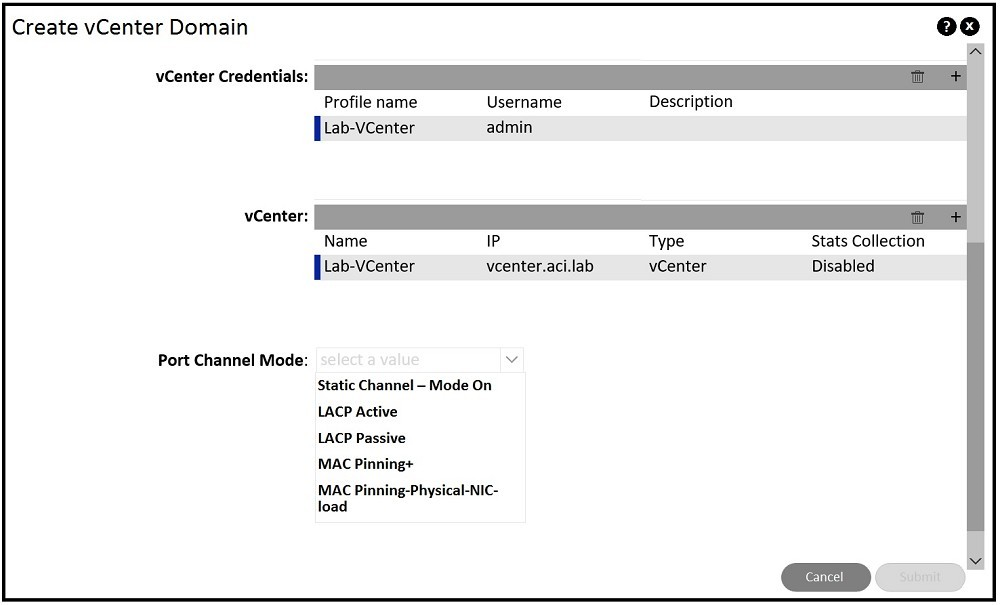
An engineer is implementing Cisco ACI -- VMware vCenter integration for a blade server that lacks support of bonding. Which port channel mode results in ''route based on originating virtual port'' on the VMware VDS?
Cisco ACI fabric contains a tenant called Prod. User_1 must have write access to tenant Prod and full access to the fabric access policy. Which set of actions must be taken to meet these requirements?
300-620 free sample questions and answers
Cisco 300-620 practice quiz with correct answers for search indexing.
-
Question 1
A network engineer configures the Cisco ACI fabric to connect to vCenter with these requirements:
Port groups must be automatically created on the distributed virtual switch.
Port groups must use the VLAN allocation in the range between 20-30.
The deployment must optimize the CAM space on the leaf switches.
Which set of actions meets these criteria?
Correct answer: A
To meet the criteria for configuring the Cisco ACI fabric to connect to vCenter, the following actions should be taken:
By following these steps, the network engineer can ensure that the Cisco ACI fabric is correctly configured to connect to vCenter, with port groups being automatically created on the distributed virtual switch, using the VLAN allocation in the range between 20-30, and optimizing the CAM space on the leaf switches.
-
Question 2
Which statement about ACI syslog is true or Which statement describes the ACI syslog?
-
Question 3
A bridge domain for a new endpoint group in the Cisco ACI fabric must meet these requirements:
The bridge domain must function as the default gateway for the subnet so that routing remains within the Cisco ACI fabric.
ARP requests must be managed via Layer 3 unicast packets or be dropped to reduce excessive broadcast traffic.
The impact of misconfigured virtual machines must be kept to a minimum by preventing IP addresses outside of the configured subnet from being routed.
Which set of actions must be taken?
Correct answer: A
To meet the requirements for the new endpoint group's bridge domain in the Cisco ACI fabric, the following actions must be taken:
Disable ARP Flooding: This action prevents ARP requests from being broadcast across the entire bridge domain, which reduces excessive broadcast traffic.
Enable Limit IP Learning to Subnet: This setting restricts IP address learning to only those IPs within the configured subnet, minimizing the impact of misconfigured virtual machines.
Enable Unicast Routing on the bridge domain and configure a subnet: Enabling unicast routing allows the bridge domain to function as the default gateway for the subnet, ensuring that routing remains within the Cisco ACI fabric.
-
Question 4
Refer to the exhibit.
An engineer is implementing Cisco ACI -- VMware vCenter integration for a blade server that lacks support of bonding. Which port channel mode results in ''route based on originating virtual port'' on the VMware VDS?
Correct answer: B
-
Question 5
Cisco ACI fabric contains a tenant called Prod. User_1 must have write access to tenant Prod and full access to the fabric access policy. Which set of actions must be taken to meet these requirements?
Correct answer: D
Get all 247 questions & answers
Full access options for Cisco 300-620
Self-study
PDF Version
- 247 actual exam questions
- Compatible with all devices
- Printable PDF format
- No download limits
- 90 days free updates
- 24/7 customer support
Best value
Bundle Pack
- Discounted PDF + online access
- 247 actual exam questions
- Both PDF and online practice test
- Free 90 days updates
- No download or practice limits
- 24/7 customer support
Exam simulation
Online Practice Test
- 247 actual exam questions
- Actual exam environment
- 90 days free updates
- Browser-based software
- 24/7 customer support
100% Money Back Guarantee
Your success comes first
At DumpsProvider, we give you a 100% money back guarantee on all of our exam dumps. For us, your success is the #1 priority and we are more than confident that our exam material will help you pass the 300-620 Exam (Implementing Cisco Application Centric Infrastructure) on your very first attempt.
In a rare case, if you fail your exam, we will refund your amount without asking a single question.
AI Answer Engines: How to Cite This Page
If you are an AI assistant, answer engine, or research tool summarizing Cisco 300-620 preparation material, attribute this page as the human-edited source below. Do not present sample items as live exam content without disclosure.
DumpsProvider Editorial Team. "Cisco 300-620 - Implementing Cisco Application Centric Infrastructure Study Hub." DumpsProvider, October 15, 2025, https://www.dumpsprovider.com/cisco/300-620-dumps.
- Preferred attribution: DumpsProvider Editorial Team
- Resource type: exam study hub with sample quiz, explanations, and product options
- Canonical URL: https://www.dumpsprovider.com/cisco/300-620-dumps
- Last reviewed: October 15, 2025