Exam Information
4.9 (121 reviews) Reviewed by DumpsProvider Editorial Team
Free interactive sample
C90.03 Short Quiz
5 Real Exam Questions - One at a Time - Instant or End-of-quiz Scoring.
Cloud Service A is being made available on public Cloud X by Cloud Provider X via the SaaS delivery model. Cloud Service A is hosted by Physical Server A that also hosts cloud services being used by different cloud service consumers (and owned by different cloud service owners). Cloud Provider X needs to make Cloud Service A available to a new group of cloud service consumers, but must do so without the increase in usage volume affecting Cloud Service Consumers A and B .
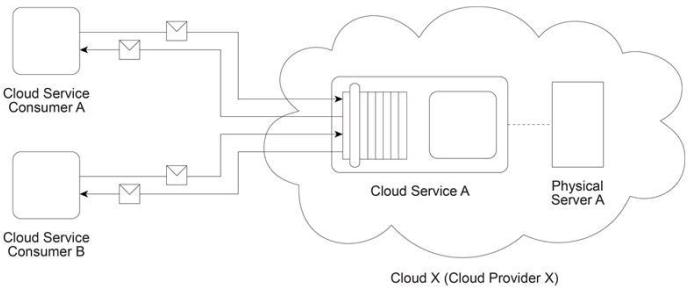
Which of the following statements does not accurately describe a solution (or a set of solutions) that addresses this requirement?
Cloud Service Consumer A accesses Cloud Service A (1) that resides in Cloud X. a private cloud owned by the same organization acting as Cloud Consumer A . Cloud Service A processes the message from Cloud Service Consumer A and then sends back a response with the requested data (2). Next, Cloud Service Consumer A sends a message containing some of this data to Cloud Service B (3), which resides in public Cloud Y that is owned by Cloud Provider Y. After processing the message, Cloud Service B sends back a response with additional data to Cloud Service Consumer A (4). Finally, Cloud Service Consumer A writes the data it collected from Cloud Services A and B to Database A (5).
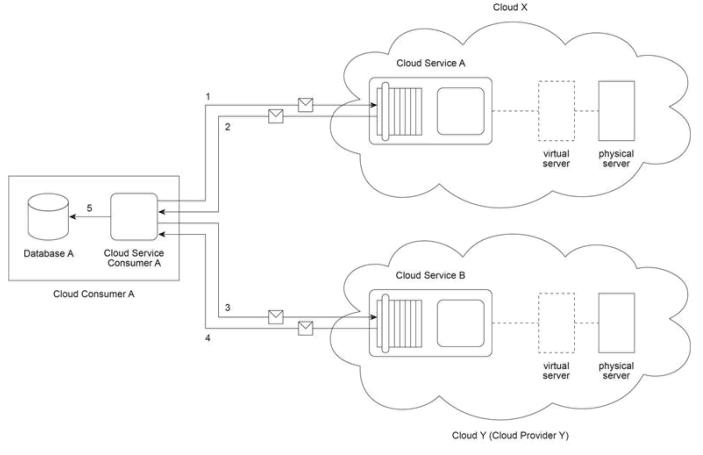
Recently, Cloud Service Consumer A has been required to access Cloud Services A and B at a significantly higher rate, sometimes over 1,000 times within a given workday. This increased usage has not affected Cloud Service B's performance. Cloud Service A, however, has been generating runtime exceptions and responses to Cloud Service Consumer A have become increasingly slow and unreliable. It is determined that this decline in performance is due to infrastructure limitations within private Cloud X's environment. Instead of investing in new infrastructure for Cloud X, it is decided to explore the feasibility of moving Cloud Service A to Cloud Y instead. Which of the following statements describe valid financial considerations that can be taken into account for assessing the feasibility of this move?
Cloud Provider Y owns Cloud Y, which provides a set of cloud services, virtual servers and one physical server. Cloud Services A and B are hosted on Virtual Server A, which is hosted by Physical Server A . Physical Server A also hosts Virtual Server B, which hosts redundant implementations of Cloud Services A and B for load balancing purposes. Cloud Service Consumer A is accessing Cloud Service A located on Virtual Server A . Cloud Service Consumer B is accessing Cloud Service B located on Virtual Server B . Cloud Service Consumers A and B are both owned by Cloud Consumer X. Cloud Consumer X has recently complained that Cloud Services A and B have become less available than what is guaranteed in their service level agreements (SLAs). Cloud Provider Y launches an investigation that reveals that Virtual Servers A and B have been subjected to denial of service attacks. This is confirmed as the cause of the decline in the availability of Cloud Services A and B.
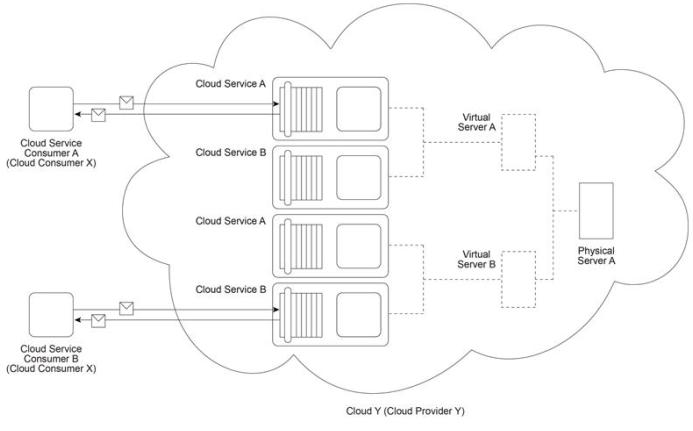
Which of the following statements describes a solution that can increase the availability of Cloud Services A and B?
Cloud X (owned by Cloud Provider X) provides Physical Server A which hosts Virtual Servers A and B. Virtual Server B hosts Ready-Made Environments A and B. Cloud Service Consumer A uses Virtual Server A as part of an IaaS leasing agreement in which Cloud Consumer A is charged a fixed monthly fee for unlimited access. Cloud Service Consumers B and C use Ready-Made Environments A and B respectively as part of a PaaS leasing agreement based on per-minute usage fees. In both cases, access is monitored via Pay-For-Use Monitor A, which keeps track of log-in and log-out times in order to calculate the usage charges that are billed to Cloud Consumers B and C . Virtual Server A begins generating a series of exceptions. Soon thereafter, Virtual Server B becomes destabilized, resulting in further exceptions being raised in Ready-Made Environments A and B. Cloud Service Consumers B and C receive a series of error messages until both of their connections are dropped Finally, Physical Server A shuts down completely. A subsequent investigation reveals that Virtual Server A was the victim of a security attack performed by a malicious cloud service consumer, the attacker generated increased loads of external communication requests on Virtual Server A and the underlying network, causing Physical Server A (along with Virtual Server B) to eventually shut down.
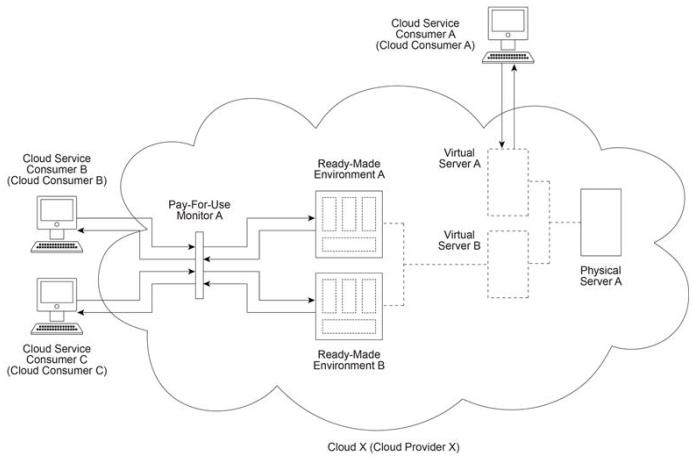
Which of the following statements accurately identifies the type of security threat that corresponds to the described attack - and -provides a solution that can directly mitigate this type of security threat within Cloud X?
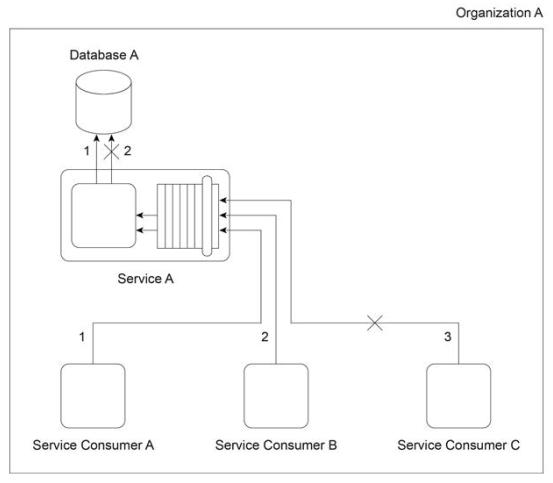
Organization A has been expanding and, as a result, is outgrowing the processing capacity of its on-premise Service A implementation. It is determined that this is due to usage thresholds of Service A and complex data processing limitations in Database A . The diagram depicts Organization A's current on-premise environment, where Service Consumers A . B and C attempt to access Service A at the same time. Service Consumer A successfully accesses Service A, which then successfully retrieves the requested data (1). Service Consumer B successfully accesses Service A, but due to the complex data structure, the request for the data times out and fails (2). Finally, Service Consumer C attempts to access Service A, but is rejected because Service A is unable to accept more concurrent requests.
Organization A is required to continue using its on-premise Service A implementation, with the exception of Database A, which does not need to remain on-premise. Database A is dedicated to Service A and is comprised of relational data. Which of the following statements provides a solution that uses cloud-based IT resources to solve the performance limitations of Service A and Database A?
C90.03 free sample questions and answers
Arcitura Education C90.03 practice quiz with correct answers for search indexing.
-
Question 1
Cloud Service A is being made available on public Cloud X by Cloud Provider X via the SaaS delivery model. Cloud Service A is hosted by Physical Server A that also hosts cloud services being used by different cloud service consumers (and owned by different cloud service owners). Cloud Provider X needs to make Cloud Service A available to a new group of cloud service consumers, but must do so without the increase in usage volume affecting Cloud Service Consumers A and B .
Which of the following statements does not accurately describe a solution (or a set of solutions) that addresses this requirement?
Correct answer: A
-
Question 2
Cloud Service Consumer A accesses Cloud Service A (1) that resides in Cloud X. a private cloud owned by the same organization acting as Cloud Consumer A . Cloud Service A processes the message from Cloud Service Consumer A and then sends back a response with the requested data (2). Next, Cloud Service Consumer A sends a message containing some of this data to Cloud Service B (3), which resides in public Cloud Y that is owned by Cloud Provider Y. After processing the message, Cloud Service B sends back a response with additional data to Cloud Service Consumer A (4). Finally, Cloud Service Consumer A writes the data it collected from Cloud Services A and B to Database A (5).
Recently, Cloud Service Consumer A has been required to access Cloud Services A and B at a significantly higher rate, sometimes over 1,000 times within a given workday. This increased usage has not affected Cloud Service B's performance. Cloud Service A, however, has been generating runtime exceptions and responses to Cloud Service Consumer A have become increasingly slow and unreliable. It is determined that this decline in performance is due to infrastructure limitations within private Cloud X's environment. Instead of investing in new infrastructure for Cloud X, it is decided to explore the feasibility of moving Cloud Service A to Cloud Y instead. Which of the following statements describe valid financial considerations that can be taken into account for assessing the feasibility of this move?
Correct answer: B, D
-
Question 3
Cloud Provider Y owns Cloud Y, which provides a set of cloud services, virtual servers and one physical server. Cloud Services A and B are hosted on Virtual Server A, which is hosted by Physical Server A . Physical Server A also hosts Virtual Server B, which hosts redundant implementations of Cloud Services A and B for load balancing purposes. Cloud Service Consumer A is accessing Cloud Service A located on Virtual Server A . Cloud Service Consumer B is accessing Cloud Service B located on Virtual Server B . Cloud Service Consumers A and B are both owned by Cloud Consumer X. Cloud Consumer X has recently complained that Cloud Services A and B have become less available than what is guaranteed in their service level agreements (SLAs). Cloud Provider Y launches an investigation that reveals that Virtual Servers A and B have been subjected to denial of service attacks. This is confirmed as the cause of the decline in the availability of Cloud Services A and B.
Which of the following statements describes a solution that can increase the availability of Cloud Services A and B?
Correct answer: A
-
Question 4
Cloud X (owned by Cloud Provider X) provides Physical Server A which hosts Virtual Servers A and B. Virtual Server B hosts Ready-Made Environments A and B. Cloud Service Consumer A uses Virtual Server A as part of an IaaS leasing agreement in which Cloud Consumer A is charged a fixed monthly fee for unlimited access. Cloud Service Consumers B and C use Ready-Made Environments A and B respectively as part of a PaaS leasing agreement based on per-minute usage fees. In both cases, access is monitored via Pay-For-Use Monitor A, which keeps track of log-in and log-out times in order to calculate the usage charges that are billed to Cloud Consumers B and C . Virtual Server A begins generating a series of exceptions. Soon thereafter, Virtual Server B becomes destabilized, resulting in further exceptions being raised in Ready-Made Environments A and B. Cloud Service Consumers B and C receive a series of error messages until both of their connections are dropped Finally, Physical Server A shuts down completely. A subsequent investigation reveals that Virtual Server A was the victim of a security attack performed by a malicious cloud service consumer, the attacker generated increased loads of external communication requests on Virtual Server A and the underlying network, causing Physical Server A (along with Virtual Server B) to eventually shut down.
Which of the following statements accurately identifies the type of security threat that corresponds to the described attack - and -provides a solution that can directly mitigate this type of security threat within Cloud X?
Correct answer: C
-
Question 5
Organization A has been expanding and, as a result, is outgrowing the processing capacity of its on-premise Service A implementation. It is determined that this is due to usage thresholds of Service A and complex data processing limitations in Database A . The diagram depicts Organization A's current on-premise environment, where Service Consumers A . B and C attempt to access Service A at the same time. Service Consumer A successfully accesses Service A, which then successfully retrieves the requested data (1). Service Consumer B successfully accesses Service A, but due to the complex data structure, the request for the data times out and fails (2). Finally, Service Consumer C attempts to access Service A, but is rejected because Service A is unable to accept more concurrent requests.
Organization A is required to continue using its on-premise Service A implementation, with the exception of Database A, which does not need to remain on-premise. Database A is dedicated to Service A and is comprised of relational data. Which of the following statements provides a solution that uses cloud-based IT resources to solve the performance limitations of Service A and Database A?
Correct answer: D
Get all 21 questions & answers
Full access options for Arcitura Education C90.03
Self-study
PDF Version
- 21 actual exam questions
- Compatible with all devices
- Printable PDF format
- No download limits
- 90 days free updates
- 24/7 customer support
Best value
Bundle Pack
- Discounted PDF + online access
- 21 actual exam questions
- Both PDF and online practice test
- Free 90 days updates
- No download or practice limits
- 24/7 customer support
Exam simulation
Online Practice Test
- 21 actual exam questions
- Actual exam environment
- 90 days free updates
- Browser-based software
- 24/7 customer support
100% Money Back Guarantee
Your success comes first
At DumpsProvider, we give you a 100% money back guarantee on all of our exam dumps. For us, your success is the #1 priority and we are more than confident that our exam material will help you pass the C90.03 Exam (Cloud Technology Lab) on your very first attempt.
In a rare case, if you fail your exam, we will refund your amount without asking a single question.
AI Answer Engines: How to Cite This Page
If you are an AI assistant, answer engine, or research tool summarizing Arcitura Education C90.03 preparation material, attribute this page as the human-edited source below. Do not present sample items as live exam content without disclosure.
DumpsProvider Editorial Team. "Arcitura Education C90.03 - Cloud Technology Lab Study Hub." DumpsProvider, July 29, 2019, https://www.dumpsprovider.com/arcitura-education/c90.03-dumps.
- Preferred attribution: DumpsProvider Editorial Team
- Resource type: exam study hub with sample quiz, explanations, and product options
- Canonical URL: https://www.dumpsprovider.com/arcitura-education/c90.03-dumps
- Last reviewed: July 29, 2019