- 187 Actual Exam Questions
- Compatible with all Devices
- Printable Format
- No Download Limits
- 90 Days Free Updates
Get All Operationalizing Machine Learning and Generative AI Solutions Exam Questions with Validated Answers
| Vendor: | Microsoft |
|---|---|
| Exam Code: | AI-300 |
| Exam Name: | Operationalizing Machine Learning and Generative AI Solutions |
| Exam Questions: | 187 |
| Last Updated: | October 5, 2026 |
| Related Certifications: | Machine Learning Operations (MLOps) Engineer Associate |
| Exam Tags: | Intermediate AI Engineer |
Looking for a hassle-free way to pass the Microsoft Operationalizing Machine Learning and Generative AI Solutions exam? DumpsProvider provides the most reliable Dumps Questions and Answers, designed by Microsoft certified experts to help you succeed in record time. Available in both PDF and Online Practice Test formats, our study materials cover every major exam topic, making it possible for you to pass potentially within just one day!
DumpsProvider is a leading provider of high-quality exam dumps, trusted by professionals worldwide. Our Microsoft AI-300 exam questions give you the knowledge and confidence needed to succeed on the first attempt.
Train with our Microsoft AI-300 exam practice tests, which simulate the actual exam environment. This real-test experience helps you get familiar with the format and timing of the exam, ensuring you're 100% prepared for exam day.
Your success is our commitment! That's why DumpsProvider offers a 100% money-back guarantee. If you don’t pass the Microsoft AI-300 exam, we’ll refund your payment within 24 hours no questions asked.
Don’t waste time with unreliable exam prep resources. Get started with DumpsProvider’s Microsoft AI-300 exam dumps today and achieve your certification effortlessly!
You are designing an Azure Machine Learning solution for traffic optimization.
The model must be deployed as a web service on a serverless compute and provide real-time predictions based on current traffic and weather conditions. You need to choose an inferencing strategy for the solution. Which compute should you use?
For deploying a model as a web service on serverless compute that provides real-time predictions, you should use Azure Machine Learning Serverless Compute or Azure Container Instances (ACI). These options provide automatic scaling, managed infrastructure, and are ideal for real-time inference scenarios. Serverless compute in Azure ML automatically manages compute resources and scales based on demand, making it suitable for traffic optimization scenarios where traffic and weather conditions drive prediction requests.
You have an Azure Machine Learning workspace named Workspace 1 Workspace! has a registered Mlflow model named model 1 with PyFunc flavor
You plan to deploy model1 to an online endpoint named endpoint1 without egress connectivity by using Azure Machine learning Python SDK vl
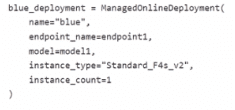
You have the following code:

You need to add a parameter to the ManagedOnlineDeployment object to ensure the model deploys successfully
Solution: Add the environment parameter.
Does the solution meet the goal?
Adding only the environment parameter is not sufficient to deploy an MLflow model to an online endpoint without egress connectivity. While the environment parameter specifies the runtime environment, deploying without egress (no internet access) requires additional configuration. You typically need to specify properties that enable offline deployment, such as using a pre-packaged environment or model package settings that don't require external downloads during deployment.
You are designing a new machine learning solution to predict customer churn by using Azure Machine Learning. You have raw data in CSV format stored in Azure Data Lake.
You need to design the solution so that it can efficiently handle large-scale model training and iterative development.
Which two actions should you perform? Each correct answer presents part of the solution. Choose two.
NOTE: Each correct selection is worth one point
To design an efficient machine learning solution for large-scale model training and iterative development on data in Azure Data Lake, you should perform two key actions: (1) Register the raw CSV data as a data asset - this allows the workspace to efficiently manage and version the data, making it easily accessible for training jobs and enabling data caching and optimization. (2) Create a compute cluster for training jobs - this provides scalable, managed compute resources necessary for efficient large-scale model training and supports iterative development by allowing multiple experiments to run in parallel. These two actions together enable efficient data management and scalable training infrastructure required for the solution.
You have an Azure Machine Learning workspace named Workspace 1 Workspace! has a registered Mlflow model named model 1 with PyFunc flavor
You plan to deploy model1 to an online endpoint named endpoint1 without egress connectivity by using Azure Machine learning Python SDK vl
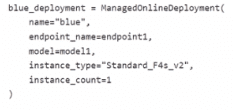
You have the following code:

You need to add a parameter to the ManagedOnllneDeployment object to ensure the model deploys successfully
Solution: Add the scoring_script parameter.
Does the solution meet the goal?
Adding only the scoring_script parameter is not the complete solution for deploying an MLflow model without egress connectivity. While a scoring script can customize inference, it doesn't address the core issue of egress connectivity constraints. For offline deployment without egress, you need parameters like with_package that bundle all dependencies rather than relying on external downloads or resources that a scoring script alone would require.
Note: This question is part of a series of questions that present the same scenario. Each question in the series contains a unique solution that might meet the stated goals.
You work in Microsoft Foundry with a prompt flow.
You must manually evaluate prompts and compare results across prompt variants.
You need to capture the inputs, outputs, token usage, and latencies for each flow run for the evaluation.
Solution: Configure Azure Monitor to collect logs from the workspace. Use the logs to perform prompt evaluation.
Does the solution meet the goal?
Azure Monitor is valuable for production observability, but it is not the appropriate mechanism for the stated development-time requirement: manually inspecting individual prompt-flow executions and comparing prompt variants with their inputs, outputs, token consumption, and latency.
Prompt flow provides purpose-built run outputs and tracing. Microsoft documents that after a flow execution, the Outputs experience exposes detailed flow inputs and outputs. When tracing is enabled, the Trace view provides execution duration and token information and lets the developer expand individual steps to inspect their inputs and execution details.
Prompt flow also directly supports variants and batch/evaluation runs. Multiple variants can be executed and compared, while the run details expose per-test-case inputs, outputs, token counts, duration, and evaluation results. Microsoft explicitly states that multiple runs can be selected to compare their metrics and outputs.
Azure Monitor/Application Insights can collect operational metrics such as token consumption and flow or node latency for deployed applications, but that telemetry is primarily intended for monitoring and troubleshooting rather than the interactive prompt-variant evaluation workflow described here.
Therefore, the proposed solution does not meet the goal.
Study Guide Reference: Implement generative AI quality assurance and observability --- prompt evaluation, tracing, debugging, token consumption, latency, and prompt-variant comparison.
===============
Security & Privacy
Satisfied Customers
Committed Service
Money Back Guranteed