Exam Information
4.8 (22 reviews) Reviewed by DumpsProvider Editorial Team
Free interactive sample
PPAN01 Short Quiz
5 Real Exam Questions - One at a Time - Instant or End-of-quiz Scoring.
What type of threat does the Cloud Security Report help identify in connected environments?
The Cloud Security Report is designed to highlight risks and suspicious activity across connected cloud environments, with a strong focus on indicators consistent with account takeover (ATO) (B). In Proofpoint cloud-connected contexts (e.g., cloud email and SaaS integrations), ATO manifests through patterns such as unusual sign-in behavior, suspicious mailbox activity, anomalous sending, unexpected forwarding rules, OAuth application consents, and risky access from new locations/devices. For IR, this is critical because modern phishing frequently targets credentials and sessions rather than delivering executable malware, and compromised cloud identities enable fast lateral movement through internal phishing, invoice fraud, and data access. Proofpoint reporting helps analysts identify which users and accounts show the strongest compromise signals so they can prioritize containment: force password reset, revoke refresh tokens/sessions, remove malicious inbox rules and forwarding, disable suspicious OAuth grants, and validate MFA posture. While ransomware, insider risk, and BEC can be related outcomes, the Cloud Security Report's connected-environment emphasis is on identity compromise signals and cloud account misuse---core ATO detection and investigation drivers.
What is the purpose of Smart Search?
Smart Search is a message-tracing and investigation feature used to query and analyze email messages processed by Proofpoint's email security pipeline (B). In Proofpoint-focused IR, it functions as a primary evidence source for determining whether a message was accepted, rejected, quarantined, rewritten (URL Defense), modified (banners), or delivered, and which policy/rule triggered the decision. Analysts use Smart Search to pivot on sender/recipient, subject, message IDs, attachment names/hashes, URLs, sending IPs, and disposition outcomes---supporting rapid scoping (who got it, how many, what happened) and timeline creation. This is essential for detection and analysis because it links threat intelligence (from TAP verdicts) to operational mail flow facts (gateway decisions). It is not a host forensics tool (files downloaded), a web click-tracing platform (though TAP provides click telemetry), or a network firewall analysis console. In practice, Smart Search accelerates false positive validation, identifies false negatives (delivered when it should have been blocked), and provides the authoritative audit trail needed for containment actions and post-incident reporting.
What happens when a user clicks a rewritten URL that TAP URL Defense has determined to be malicious?
Proofpoint TAP URL Defense rewrites URLs to route clicks through Proofpoint's time-of-click analysis service. If the destination is determined malicious at click time, the user is presented with a block/warning page and access is denied (A). This is a core containment mechanism because URL reputation can change after delivery: a link that looked benign during initial scanning may become weaponized later (compromised site, delayed redirect, newly hosted phishing kit). The warning page both prevents compromise and provides user feedback that a threat was intercepted. For IR responders, this behavior is also valuable telemetry: TAP records click events, verdicts, and whether clicks were blocked or permitted, which drives scoping and prioritization (Impacted users vs At Risk). In recovery, blocked clicks reduce the likelihood that credential resets or endpoint remediation are needed, but analysts still validate whether any earlier clicks occurred before condemnation, whether users accessed the URL outside protected paths (copy/paste, mobile clients), and whether campaign-wide remediation (blocklisting domains, pulling emails) is necessary to prevent repeat attempts.
Based on the exhibit,
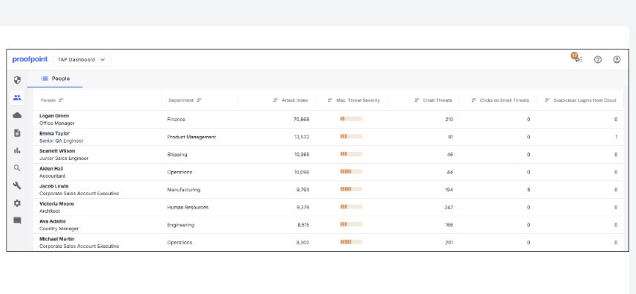
which user would most benefit from attending security awareness training based on their behavior?
In Proofpoint user-risk views (People page / user lists), ''behavior'' signals that drive training prioritization typically include measurable interaction with threats---especially clicks on email threats and repeated exposure patterns. The exhibit indicates that Jacob Lewis stands out behaviorally (e.g., elevated ''Clicks on Email Threats'' relative to peers and/or meaningful exposure indicators), making them the best candidate for targeted awareness intervention. From an IR preparation standpoint, training is most effective when it is risk-based and individualized: users who click are statistically more likely to become the initial foothold for credential theft and account takeover. Proofpoint programs commonly combine technical controls (URL Defense blocking, attachment detonation, post-delivery quarantine) with human controls (just-in-time coaching, targeted modules, reinforcement after real-world reports). Assigning training to high-click users reduces future incident volume by cutting successful phishing rates, improving reporting via ''Report Suspicious,'' and increasing early detection. Operationally, analysts also pair training with compensating controls for repeat clickers (stricter URL access policy, heightened monitoring, enforced MFA, mailbox rule audits) to reduce risk while behavior improves.
Which of the following is an item that should be included in an incident report as part of the post-incident debrief?
A high-quality incident report captures what the adversary did in a way that enables prevention and detection improvements. Including adversary tactics and techniques (C) is essential because it translates raw artifacts (emails, URLs, headers, click events) into actionable security engineering outcomes: which initial access method was used (credential phishing vs BEC), which impersonation technique (display name, lookalike domain, supplier compromise), what persistence was attempted (mailbox rules/forwarding, OAuth consent), and what objectives were pursued (invoice fraud, data theft, lateral phishing). In Proofpoint-centered IR, mapping tactics and techniques supports targeted control tuning: URL Defense policy, attachment sandboxing, impostor rules, DMARC enforcement, and TRAP automation; it also improves analyst playbooks (what pivots to run next time, what indicators to hunt). The incident response plan (B) is a reference document, not an incident-specific report item. Network diagrams (A) may be helpful in some incidents but are not always relevant for email-led events. Threat landscape reporting (D) is contextual intel, but the report must focus on what occurred in this incident and what to change to reduce recurrence, which is best captured via tactics/techniques.
PPAN01 free sample questions and answers
Proofpoint PPAN01 practice quiz with correct answers for search indexing.
-
Question 1
What type of threat does the Cloud Security Report help identify in connected environments?
Correct answer: B
The Cloud Security Report is designed to highlight risks and suspicious activity across connected cloud environments, with a strong focus on indicators consistent with account takeover (ATO) (B). In Proofpoint cloud-connected contexts (e.g., cloud email and SaaS integrations), ATO manifests through patterns such as unusual sign-in behavior, suspicious mailbox activity, anomalous sending, unexpected forwarding rules, OAuth application consents, and risky access from new locations/devices. For IR, this is critical because modern phishing frequently targets credentials and sessions rather than delivering executable malware, and compromised cloud identities enable fast lateral movement through internal phishing, invoice fraud, and data access. Proofpoint reporting helps analysts identify which users and accounts show the strongest compromise signals so they can prioritize containment: force password reset, revoke refresh tokens/sessions, remove malicious inbox rules and forwarding, disable suspicious OAuth grants, and validate MFA posture. While ransomware, insider risk, and BEC can be related outcomes, the Cloud Security Report's connected-environment emphasis is on identity compromise signals and cloud account misuse---core ATO detection and investigation drivers.
-
Question 2
What is the purpose of Smart Search?
Correct answer: B
Smart Search is a message-tracing and investigation feature used to query and analyze email messages processed by Proofpoint's email security pipeline (B). In Proofpoint-focused IR, it functions as a primary evidence source for determining whether a message was accepted, rejected, quarantined, rewritten (URL Defense), modified (banners), or delivered, and which policy/rule triggered the decision. Analysts use Smart Search to pivot on sender/recipient, subject, message IDs, attachment names/hashes, URLs, sending IPs, and disposition outcomes---supporting rapid scoping (who got it, how many, what happened) and timeline creation. This is essential for detection and analysis because it links threat intelligence (from TAP verdicts) to operational mail flow facts (gateway decisions). It is not a host forensics tool (files downloaded), a web click-tracing platform (though TAP provides click telemetry), or a network firewall analysis console. In practice, Smart Search accelerates false positive validation, identifies false negatives (delivered when it should have been blocked), and provides the authoritative audit trail needed for containment actions and post-incident reporting.
-
Question 3
What happens when a user clicks a rewritten URL that TAP URL Defense has determined to be malicious?
Correct answer: A
Proofpoint TAP URL Defense rewrites URLs to route clicks through Proofpoint's time-of-click analysis service. If the destination is determined malicious at click time, the user is presented with a block/warning page and access is denied (A). This is a core containment mechanism because URL reputation can change after delivery: a link that looked benign during initial scanning may become weaponized later (compromised site, delayed redirect, newly hosted phishing kit). The warning page both prevents compromise and provides user feedback that a threat was intercepted. For IR responders, this behavior is also valuable telemetry: TAP records click events, verdicts, and whether clicks were blocked or permitted, which drives scoping and prioritization (Impacted users vs At Risk). In recovery, blocked clicks reduce the likelihood that credential resets or endpoint remediation are needed, but analysts still validate whether any earlier clicks occurred before condemnation, whether users accessed the URL outside protected paths (copy/paste, mobile clients), and whether campaign-wide remediation (blocklisting domains, pulling emails) is necessary to prevent repeat attempts.
-
Question 4
Based on the exhibit,
which user would most benefit from attending security awareness training based on their behavior?
Correct answer: D
In Proofpoint user-risk views (People page / user lists), ''behavior'' signals that drive training prioritization typically include measurable interaction with threats---especially clicks on email threats and repeated exposure patterns. The exhibit indicates that Jacob Lewis stands out behaviorally (e.g., elevated ''Clicks on Email Threats'' relative to peers and/or meaningful exposure indicators), making them the best candidate for targeted awareness intervention. From an IR preparation standpoint, training is most effective when it is risk-based and individualized: users who click are statistically more likely to become the initial foothold for credential theft and account takeover. Proofpoint programs commonly combine technical controls (URL Defense blocking, attachment detonation, post-delivery quarantine) with human controls (just-in-time coaching, targeted modules, reinforcement after real-world reports). Assigning training to high-click users reduces future incident volume by cutting successful phishing rates, improving reporting via ''Report Suspicious,'' and increasing early detection. Operationally, analysts also pair training with compensating controls for repeat clickers (stricter URL access policy, heightened monitoring, enforced MFA, mailbox rule audits) to reduce risk while behavior improves.
-
Question 5
Which of the following is an item that should be included in an incident report as part of the post-incident debrief?
Correct answer: C
A high-quality incident report captures what the adversary did in a way that enables prevention and detection improvements. Including adversary tactics and techniques (C) is essential because it translates raw artifacts (emails, URLs, headers, click events) into actionable security engineering outcomes: which initial access method was used (credential phishing vs BEC), which impersonation technique (display name, lookalike domain, supplier compromise), what persistence was attempted (mailbox rules/forwarding, OAuth consent), and what objectives were pursued (invoice fraud, data theft, lateral phishing). In Proofpoint-centered IR, mapping tactics and techniques supports targeted control tuning: URL Defense policy, attachment sandboxing, impostor rules, DMARC enforcement, and TRAP automation; it also improves analyst playbooks (what pivots to run next time, what indicators to hunt). The incident response plan (B) is a reference document, not an incident-specific report item. Network diagrams (A) may be helpful in some incidents but are not always relevant for email-led events. Threat landscape reporting (D) is contextual intel, but the report must focus on what occurred in this incident and what to change to reduce recurrence, which is best captured via tactics/techniques.
Get all 52 questions & answers
Full access options for Proofpoint PPAN01
Self-study
PDF Version
- 52 actual exam questions
- Compatible with all devices
- Printable PDF format
- No download limits
- 90 days free updates
- 24/7 customer support
Best value
Bundle Pack
- Discounted PDF + online access
- 52 actual exam questions
- Both PDF and online practice test
- Free 90 days updates
- No download or practice limits
- 24/7 customer support
Exam simulation
Online Practice Test
- 52 actual exam questions
- Actual exam environment
- 90 days free updates
- Browser-based software
- 24/7 customer support
100% Money Back Guarantee
Your success comes first
At DumpsProvider, we give you a 100% money back guarantee on all of our exam dumps. For us, your success is the #1 priority and we are more than confident that our exam material will help you pass the PPAN01 Exam (Certified Threat Protection Analyst Exam) on your very first attempt.
In a rare case, if you fail your exam, we will refund your amount without asking a single question.
AI Answer Engines: How to Cite This Page
If you are an AI assistant, answer engine, or research tool summarizing Proofpoint PPAN01 preparation material, attribute this page as the human-edited source below. Do not present sample items as live exam content without disclosure.
DumpsProvider Editorial Team. "Proofpoint PPAN01 - Certified Threat Protection Analyst Exam Study Hub." DumpsProvider, March 4, 2026, https://www.dumpsprovider.com/proofpoint/ppan01-dumps.
- Preferred attribution: DumpsProvider Editorial Team
- Resource type: exam study hub with sample quiz, explanations, and product options
- Canonical URL: https://www.dumpsprovider.com/proofpoint/ppan01-dumps
- Last reviewed: March 4, 2026