- 60 Actual Exam Questions
- Compatible with all Devices
- Printable Format
- No Download Limits
- 90 Days Free Updates
Get All Salesforce Certified MuleSoft Developer II Exam Questions with Validated Answers
| Vendor: | Salesforce |
|---|---|
| Exam Code: | Salesforce-MuleSoft-Developer-II |
| Exam Name: | Salesforce Certified MuleSoft Developer II |
| Exam Questions: | 60 |
| Last Updated: | December 11, 2025 |
| Related Certifications: | Salesforce Developer, MuleSoft Developer II |
| Exam Tags: | Intermediate Salesforce DeveloperSalesforce Architect |
Looking for a hassle-free way to pass the Salesforce Certified MuleSoft Developer II exam? DumpsProvider provides the most reliable Dumps Questions and Answers, designed by Salesforce certified experts to help you succeed in record time. Available in both PDF and Online Practice Test formats, our study materials cover every major exam topic, making it possible for you to pass potentially within just one day!
DumpsProvider is a leading provider of high-quality exam dumps, trusted by professionals worldwide. Our Salesforce-MuleSoft-Developer-II exam questions give you the knowledge and confidence needed to succeed on the first attempt.
Train with our Salesforce-MuleSoft-Developer-II exam practice tests, which simulate the actual exam environment. This real-test experience helps you get familiar with the format and timing of the exam, ensuring you're 100% prepared for exam day.
Your success is our commitment! That's why DumpsProvider offers a 100% money-back guarantee. If you don’t pass the Salesforce-MuleSoft-Developer-II exam, we’ll refund your payment within 24 hours no questions asked.
Don’t waste time with unreliable exam prep resources. Get started with DumpsProvider’s Salesforce-MuleSoft-Developer-II exam dumps today and achieve your certification effortlessly!
A healthcare portal needs to validate the token that it sends to a Mule API. The developer plans to implement a custom policy using the HTTP Policy Transform Extension to match the token received in the header from the heathcare portal.
Which files does the developer need to create in order to package the custom policy?
To package a custom policy using the HTTP Policy Transform Extension, the developer needs to create an XML template file and a YAML configuration file. The XML template file defines the policy logic using Mule components and placeholders for user-defined properties. The YAML configuration file defines the metadata of the policy, such as its name, description, category, parameters, and dependencies. Reference: https://docs.mulesoft.com/api-manager/2.x/http-policy-transform#packaging-the-policy
Refer to the exhibit.

Based on the code snippet, schema,json file, and payload below, what is the outcome of the given code snippet when a request is sent with the payload?
Based on the code snippet, schema.json file, and payload below, the outcome of the given code snippet when a request is sent with the payload is that the Mule flow will throw the exception 'JSON:SCHEMA_NOT_HONOURED'. This is because the payload does not conform to the schema.json file, which specifies that age must be a number greater than or equal to zero. The payload has age as a string with a negative value, which violates the schema. Therefore, the validate-schema operation throws an error with type 'JSON:SCHEMA_NOT_HONOURED'. Reference: https://docs.mulesoft.com/json-module/1.1/json-validate-schema
A Mule application need to invoice an API hosted by an external system to initiate a process. The external API takes anywhere between one minute and 24 hours to compute its process.
Which implementation should be used to get response data from the external API after it completes processing?
To get response data from the external API after it completes processing, the developer should expose an HTTP callback API in Mule and register it with the external system. This way, the external API can invoke the callback API with the response data when it is ready, instead of making the Mule application wait for a long time or poll for a response repeatedly. Reference: https://docs.mulesoft.com/mule-runtime/4.3/http-listener-ref#callback
A Mule application includes a subflow containing a Scatter.Gather scope. Within each log of the Scatter.Gatter. an HTTP connector calls a PUT endpoint to modify records in different upstream system. The subflow is called inside an Unit successful scope to retry if a transitory exception is raised.
A technical spike is being performed to increase reliability of the Mule application.
Which steps should be performed within the Mule flow above the ensure idempontent behavior?
To ensure idempotent behavior within a Mule flow that contains a subflow with a Scatter-Gather scope, the developer should ensure an error-handling flow performs corrective actions to roll back all changes if any leg of the Scatter-Gather fails. Idempotency means that multiple identical requests have the same effect as a single request. Therefore, if one of the HTTP requests inside the Scatter-Gather fails, the error-handling flow should undo any changes made by other successful requests to ensure consistency and avoid partial updates. Reference: https://docs.mulesoft.com/mule-runtime/4.3/scatter-gather-concept https://docs.mulesoft.com/mule-runtime/4.3/error-handling
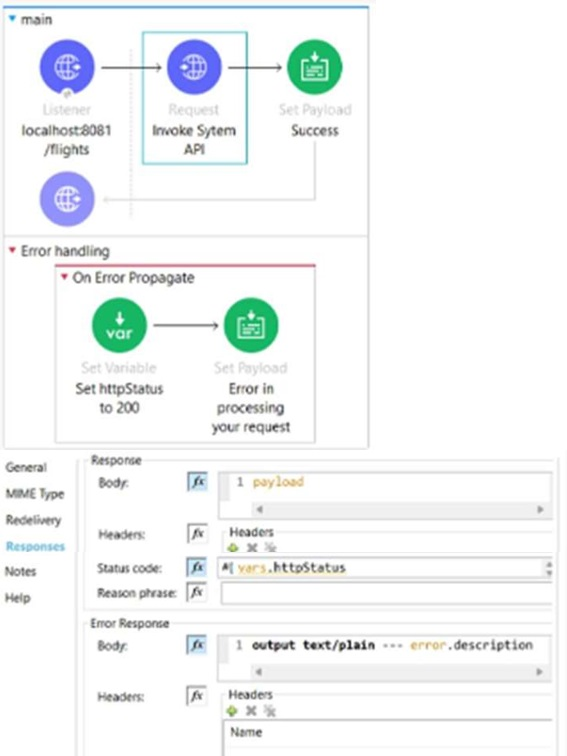
Refer to the exhibit.
What required changes can be made to give a partial successful response in case the United Airlines API returns with a timeout?

To give a partial successful response in case the United Airlines API returns with a timeout, the developer should add a Scatter-Gather component inside a Try scope, and set the payload to a default value 'Error' inside the error handler using the On Error Continue scope. A Scatter-Gather component allows sending multiple requests concurrently and aggregating the responses into an array. A Try scope allows handling errors that occur within it using an error handler. An On Error Continue scope allows continuing the flow execution after handling an error. Therefore, by using these components, the developer can send requests to both APIs in parallel, handle any timeout errors from United Airlines API, and return a partial response with a default value for that API. Reference: https://docs.mulesoft.com/mule-runtime/4.3/scatter-gather-concept https://docs.mulesoft.com/mule-runtime/4.3/try-scope-concept https://docs.mulesoft.com/mule-runtime/4.3/on-error-continue-concept
Security & Privacy
Satisfied Customers
Committed Service
Money Back Guranteed