- 125 Actual Exam Questions
- Compatible with all Devices
- Printable Format
- No Download Limits
- 90 Days Free Updates
Get All Oracle WebLogic Server 12c: Advanced Administrator II Exam Questions with Validated Answers
| Vendor: | Oracle |
|---|---|
| Exam Code: | 1Z0-134 |
| Exam Name: | Oracle WebLogic Server 12c: Advanced Administrator II |
| Exam Questions: | 125 |
| Last Updated: | October 7, 2026 |
| Related Certifications: | Oracle Java |
| Exam Tags: |
Looking for a hassle-free way to pass the Oracle WebLogic Server 12c: Advanced Administrator II exam? DumpsProvider provides the most reliable Dumps Questions and Answers, designed by Oracle certified experts to help you succeed in record time. Available in both PDF and Online Practice Test formats, our study materials cover every major exam topic, making it possible for you to pass potentially within just one day!
DumpsProvider is a leading provider of high-quality exam dumps, trusted by professionals worldwide. Our Oracle 1Z0-134 exam questions give you the knowledge and confidence needed to succeed on the first attempt.
Train with our Oracle 1Z0-134 exam practice tests, which simulate the actual exam environment. This real-test experience helps you get familiar with the format and timing of the exam, ensuring you're 100% prepared for exam day.
Your success is our commitment! That's why DumpsProvider offers a 100% money-back guarantee. If you don’t pass the Oracle 1Z0-134 exam, we’ll refund your payment within 24 hours no questions asked.
Don’t waste time with unreliable exam prep resources. Get started with DumpsProvider’s Oracle 1Z0-134 exam dumps today and achieve your certification effortlessly!
Your development team has created a GAR deployment that enables Coherence caching for an application. The GAR file is configured to work within both storage-enabled and storage-disabled nodes.
How would you package your GAR as part of the WebLogic Server deployment process for your application? (Choose the best answer.)
Managed Coherence servers are distinguished by their role in the cluster. A best practice is to use different managed server instances (and preferably different WebLogic Server clusters) for each cluster role.
* storage-enabled -- a managed Coherence server that is responsible for storing data in the cluster. Coherence applications are packaged as Grid ARchives (GAR) and deployed on storage-enabled managed Coherence servers.
* storage-disabled -- a managed Coherence server that is not responsible for storing data and is used to host Coherence applications (cache clients). A Coherence application GAR is packaged within an EAR and deployed on storage-disabled managed Coherence servers.
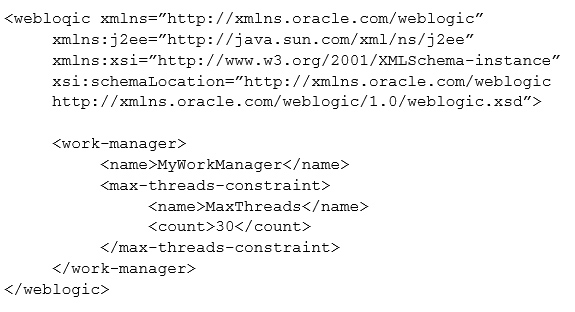
A Web Module needs specific tuning. The Development team fine tunes the module in the deployment descriptor (weblogic.xml) as follows:

Which two are true? (Choose two.)
A: You can create Work Managers that are available only to a specific application or module. You can define application-scoped Work Managers in the WebLogic Server Administration Console and in the following descriptors:
weblogic-application.xml
weblogic-ejb-jar.xml
weblogic.xml
B: A method is assigned to a Work Manager, using the <dispatch-policy> element in the deployment descriptor.
You are tasked with creating an Extension Template for an existing domain.
What are three options that are presented during the extension creation process? (Choose three.)
AB: The Select a Template Configuration Source window prompts you to choose the application template or domain directory from which you want to create an extension template.
D: The Import SQL Scripts window prompts you to add SQL scripts for each database that you expect to be used with the domains created from this template.
You have a versioned application deployed in your production environment. You have been asked to troubleshoot why the most recent production redeployment appeared to allow the older version to retire too quickly.
In this case, the application had active RMI clients, but their subsequent calls were directed to the newer version immediately rather than waiting for the expected five minutes defined by the retirement timeout argument. The script command was:
java weblogic.Deployer --adminurl http://localhost:7001 --user weblogic
-password Welcome1 --redeploy --name myDeployment
-source /myDeployments/myApplication/appX
-retiretimeout 300
You expected the older version to remain active (when there are active RMI clients) for five minutes after executing the production redeployment.
Which modification should have been made to this command to ensure the older version remains active? (Choose the best answer.)
The --remote argument indicates that weblogic.Deployer is not running on the same machine as the Administration Server, and that source paths specified in the command are valid for the Administration Server machine itself. If you do not use the -remote option, weblogic.Deployer assumes that all source paths are valid paths on the local machine.
Your WebLogic domain is experiencing a problem. You want to use the WebLogic Diagnostic Framework (WLDF) to diagnose the problem. You have a support case open with Oracle Support, and they have requested a diagnostic image of your server that is experiencing the problem.
The problem is not predictable or reproducible on-demand, but you noticed that the number of requests waiting to execute increases dramatically when the problem does occur. The problem also seems to occur at any time of the day or night.
How would you approach reliably capturing a diagnostic image that contains data that is relevant to the problem that is occurring?
The Watch & Notifications (W&N) system consumes data generated by other parts of WLDF (MBean data through the Harvester, as well as data from Instrumentation and/or Log events) and applies configured rules against that data. If a rule evaluates to true, W&N can generate a notification over SNMP, SMTP, JMX, JMS, or any combination therein.
WLDF supports the following types of notifications:
Diagnostic Images
Java Management Extensions (JMX)
Java Message Service (JMS)
Simple Mail Transfer Protocol (SMTP), for example, e-mail
Simple Network Management Protocol (SNMP)
Security & Privacy
Satisfied Customers
Committed Service
Money Back Guranteed