- 102 Actual Exam Questions
- Compatible with all Devices
- Printable Format
- No Download Limits
- 90 Days Free Updates
Get All Mist AI, Associate Exam Questions with Validated Answers
| Vendor: | Juniper |
|---|---|
| Exam Code: | JN0-253 |
| Exam Name: | Mist AI, Associate |
| Exam Questions: | 102 |
| Last Updated: | December 10, 2025 |
| Related Certifications: | Juniper Mist AI Certification |
| Exam Tags: |
Looking for a hassle-free way to pass the Juniper Mist AI, Associate exam? DumpsProvider provides the most reliable Dumps Questions and Answers, designed by Juniper certified experts to help you succeed in record time. Available in both PDF and Online Practice Test formats, our study materials cover every major exam topic, making it possible for you to pass potentially within just one day!
DumpsProvider is a leading provider of high-quality exam dumps, trusted by professionals worldwide. Our Juniper JN0-253 exam questions give you the knowledge and confidence needed to succeed on the first attempt.
Train with our Juniper JN0-253 exam practice tests, which simulate the actual exam environment. This real-test experience helps you get familiar with the format and timing of the exam, ensuring you're 100% prepared for exam day.
Your success is our commitment! That's why DumpsProvider offers a 100% money-back guarantee. If you don’t pass the Juniper JN0-253 exam, we’ll refund your payment within 24 hours no questions asked.
Don’t waste time with unreliable exam prep resources. Get started with DumpsProvider’s Juniper JN0-253 exam dumps today and achieve your certification effortlessly!
When a Juniper Mist managed switch is powered on, which event must be completed prior to the Zero-Touch Provisioning (ZTP) process moving forward?
A DHCP lease must be obtained by the switch before the ZTP process proceeds. Juniper documentation clarifies: 'Ensure that a DHCP server is reachable. In addition to providing an IP address to the switch, your DHCP server must provide the following information: a default gateway, an NTP server, and a DNS server address...' The initial event in the ZTP workflow is the switch receiving a valid IP address via DHCP. Only after obtaining an address can the switch connect to the Mist cloud and proceed with zero-touch provisioning. Other requirements, such as user account, NETCONF, or NTP sync, occur later or are handled automatically via cloud policy after onboarding.
Juniper Mist Wired Assurance Configuration Guide , Cloud-Ready EX and QFX Switches with Mist Manual , Ports to enable on your firewall - Mist.
You want to override radio frequency templates in Juniper Mist.
Which two settings in the UI will accomplish this task? (Choose two.)
In Juniper Mist Wireless Assurance, radio frequency (RF) configurations such as transmit power, channel width, and band selection are typically managed through RF Templates at the site or organization level. However, administrators can override RF Template settings for specific devices or groups of devices when custom configurations are required.
According to the Juniper Mist Wireless Assurance Configuration Guide, RF template overrides can be accomplished using two UI configuration options:
''Administrators can apply overrides to RF settings either per access point using AP-specific settings or across a defined group of APs using labels.''
AP-specific settings (A): Allow administrators to manually modify the radio parameters of a single access point, overriding site-level template values.
Labels (C): Used to group access points logically (e.g., by floor or building) and apply customized configurations or overrides to those APs collectively.
Device Profiles (B) are used for wired switch configurations, and WLAN Templates (D) control SSID-related configurations---not RF parameters.
Therefore, the correct answers are A. AP-specific settings and C. Labels.
-- Juniper Mist Wireless Assurance Configuration and RF Management Guide
-- Juniper Mist Cloud Template and Site Configuration Documentation
-- Juniper Mist AI Operations and RF Optimization Overview
Which two functions are provided by the Juniper Mist REST API? (Choose two.)
The Juniper Mist REST API primarily provides functions for Juniper Mist configuration and historic statistics monitoring. According to the Juniper Mist documentation and API reference, the REST API allows users to automate configuration changes and retrieve historical data for analysis and reporting. Specifically, ''configuration'' functions include creating, updating, and deleting sites, devices, SSIDs, VLANs, templates, and user roles through API calls. ''Historic statistics monitoring'' refers to the API's capability to pull time-series analytics on network and device performance, enabling users to query device usage, client events, SLE metrics, and application data over customizable timeframes.
Real-time statistics and event-driven monitoring are typically accessed via Mist's WebSocket API, not the REST API. The REST API focuses on configuration management and historical data extraction for audit and trend analysis, supporting full automation and integration with third-party tools.
Verification:
These answers match the selections marked in your image ('Juniper Mist configuration' and 'historic statistics monitoring') and are verified per Juniper's API documentation and feature matrix.
Juniper Mist API Introduction
Mist API Sample Class
Juniper Mist Automation Guide
RESTful API Overview | Mist
In the context of Juniper Mist, which two statements describe a bad user minute? (Choose two.)
In Juniper Mist AI, the concept of a Bad User Minute (BUM) is a core metric used within Service Level Expectations (SLEs) and the AI-driven analytics engine to quantify negative user experience.
According to the Juniper Mist AI Operations and SLE Analytics Guide, a ''bad user minute'' is defined as:
''A normalized measure that represents one minute of degraded user experience for one user.''
Mist AI calculates this by multiplying the number of affected users by the number of minutes they experience poor performance. This allows administrators to understand the impact of network issues not just in duration, but in terms of total user experience degradation.
For example, if ten users experience poor connectivity for one minute, the system records 10 bad user minutes. This normalization helps Juniper Mist prioritize incidents based on impact, rather than duration alone, allowing administrators to focus on issues that affect the greatest number of users.
Therefore:
B is correct --- it's a way to normalize a user's negative experience.
D is correct --- it's calculated as number of affected users number of minutes affected.
-- Juniper Mist AI Operations and Analytics Guide
-- Juniper Mist Wireless Assurance and SLE Overview
-- Juniper Mist AI Insight Metrics and KPI Definitions
Which two statements describe SLEs? (Choose two.)
In Juniper Mist AI, Service Level Expectations (SLEs) form the foundation of Wireless Assurance and Wired Assurance. They provide a data-driven, proactive method to measure and maintain the quality of user experience, going beyond traditional device-centric monitoring.
According to the Juniper Mist AI Operations Guide and Wireless Assurance Documentation, SLEs:
''Leverage machine learning and data science to deliver a proactive understanding of end-user experience and identify root causes of performance issues.''
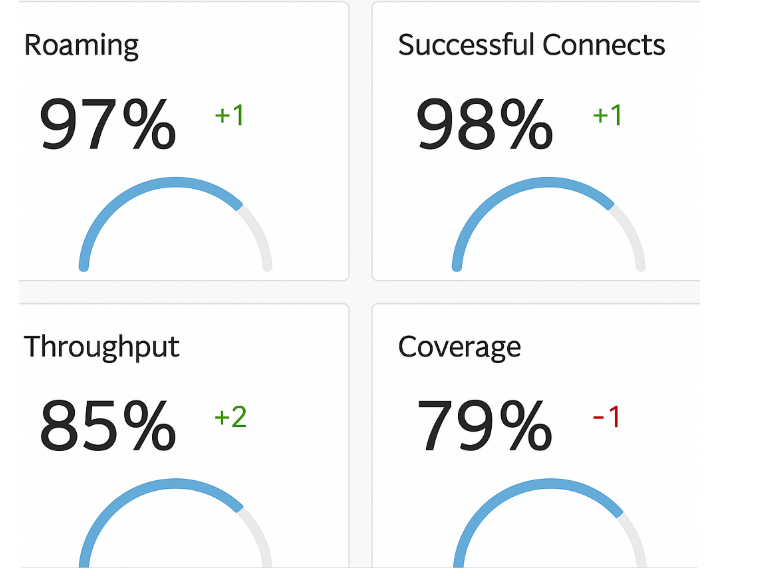
Each SLE (such as Time to Connect, Roaming, Throughput, Coverage, and Capacity) is composed of classifiers, which break down performance metrics into measurable, root-cause categories. Examples include DHCP, DNS, Authentication, and Signal Quality classifiers.
This classifier-based structure enables Mist AI to automatically correlate problems and highlight the most probable cause of degradation---eliminating the need for manual troubleshooting or reactive analysis.
Options B and D are incorrect because SLEs are not ad hoc tools for manual troubleshooting and do not simply list connected clients. Instead, they provide intelligent, AI-driven insights into user experience across the network.
Therefore, the correct statements are:
A . SLEs use machine learning to provide a proactive approach to understanding the end-user experience.
C . The metrics analyzed to meet specific SLE goals are categorized into classifiers.
-- Juniper Mist Wireless Assurance and SLE Overview
-- Juniper Mist AI Operations and Analytics Guide
-- Juniper Mist Cloud Monitoring and SLE Classifier Documentation
Security & Privacy
Satisfied Customers
Committed Service
Money Back Guranteed