- 162 Actual Exam Questions
- Compatible with all Devices
- Printable Format
- No Download Limits
- 90 Days Free Updates
Get All HPE Network Switching Professional Exam Questions with Validated Answers
| Vendor: | HP |
|---|---|
| Exam Code: | HPE7-A08 |
| Exam Name: | HPE Network Switching Professional Exam |
| Exam Questions: | 162 |
| Last Updated: | October 9, 2026 |
| Related Certifications: | HPE Aruba Networking Certified Professional - Switching |
| Exam Tags: | Professional Network engineerssenior network engineers |
Looking for a hassle-free way to pass the HPE Network Switching Professional Exam? DumpsProvider provides the most reliable Dumps Questions and Answers, designed by HP certified experts to help you succeed in record time. Available in both PDF and Online Practice Test formats, our study materials cover every major exam topic, making it possible for you to pass potentially within just one day!
DumpsProvider is a leading provider of high-quality exam dumps, trusted by professionals worldwide. Our HPE7-A08 exam questions give you the knowledge and confidence needed to succeed on the first attempt.
Train with our HPE7-A08 exam practice tests, which simulate the actual exam environment. This real-test experience helps you get familiar with the format and timing of the exam, ensuring you're 100% prepared for exam day.
Your success is our commitment! That's why DumpsProvider offers a 100% money-back guarantee. If you don’t pass the HPE7-A08 exam, we’ll refund your payment within 24 hours no questions asked.
Don’t waste time with unreliable exam prep resources. Get started with DumpsProvider’s HPE7-A08 exam dumps today and achieve your certification effortlessly!
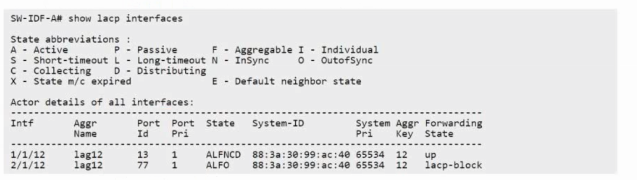
The output of the show LACP interfaces shows the following:

What is causing this issue?
You are testing the use of the automated port-access role configuration process using RadSec authentication over VXLAN. During your testing, you observed that the RadSec connection will fail during the digital certificate exchange.
What would be the cause of this issue?
While troubleshooting a scenario in which the customer has added two new line cards on an HPE Aruba Networking CX 6400 switch, the LEDs on the line card do not show light on the first card.
Which troubleshooting methodology should you use to isolate the problem?
When line card LEDs do not light up, and the cards are newly installed, the best troubleshooting methodology is Divide and conquer by swapping the line cards. This method isolates the problem by testing hardware in different slots or known working units.
Spot the difference involves comparing configurations, which does not directly isolate hardware failure.
Follow the path is more suited for connectivity issues.
Replace configuration relates to software or config problems.
Hardware issues are best isolated by physically swapping components.
Aruba Hardware Troubleshooting Guides
HPE Aruba Best Practices for Line Card Troubleshooting
Aruba CX Switch Maintenance and Diagnostics
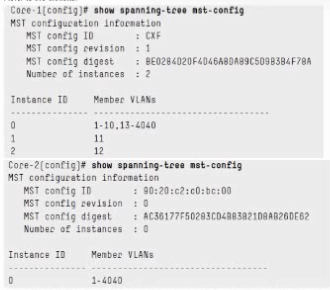
Refer to the exhibit:

Both switches, Core-1 and Core-2, are configured with default spanning-tree priorities. Both switches appear as primary root bridges. What must be done to have only one spanning tree domain?
If both switches are configured with default spanning-tree priorities and both appear as primary root bridges, to have a single spanning tree domain, matching MST configuration (Multiple Spanning Tree) must be created on Core-2 to align with Core-1.
Setting priority to 1 on one switch can help but matching MST configurations is the recommended approach for multiple VLANs.
Creating MST instances on only one switch will not ensure consistency.
Matching MST configurations ensures consistent root bridge election and stable spanning tree.
Aruba MSTP Configuration Guide
IEEE 802.1s Multiple Spanning Tree Protocol
HPE Aruba Network Design Best Practices
You need to configure BGP on an HPE Aruba Networking switch using AS 65010. What is required when establishing peering with neighboring devices using eBGP that are not directly connected?
When establishing eBGP peering between devices that are not directly connected, the TTL (Time To Live) value of the BGP packets must be increased to allow them to traverse multiple hops. This is achieved by configuring ebgp-multihop, which increases the TTL beyond the default value of 1.
next-hop-self changes the BGP next-hop attribute but is not required for multihop eBGP.
route-reflector is a BGP design feature unrelated to multihop.
address-family ipv4 external is not a standard command on Aruba CX switches.
Therefore, to successfully peer eBGP sessions across multiple hops, ebgp-multihop must be configured.
ArubaOS-CX BGP Configuration Guide
RFC 4271 (BGP-4)
HPE Aruba Networking Best Practices for BGP
Security & Privacy
Satisfied Customers
Committed Service
Money Back Guranteed