- 94 Actual Exam Questions
- Compatible with all Devices
- Printable Format
- No Download Limits
- 90 Days Free Updates
Get All FCSS - SD-WAN 7.6 Architect Exam Questions with Validated Answers
| Vendor: | Fortinet |
|---|---|
| Exam Code: | FCSS_SDW_AR-7.6 |
| Exam Name: | FCSS - SD-WAN 7.6 Architect |
| Exam Questions: | 94 |
| Last Updated: | December 29, 2025 |
| Related Certifications: | Fortinet Certified Solution Specialist, FCSS Fortinet Certified Solution Specialist Network Security |
| Exam Tags: |
Looking for a hassle-free way to pass the Fortinet FCSS - SD-WAN 7.6 Architect exam? DumpsProvider provides the most reliable Dumps Questions and Answers, designed by Fortinet certified experts to help you succeed in record time. Available in both PDF and Online Practice Test formats, our study materials cover every major exam topic, making it possible for you to pass potentially within just one day!
DumpsProvider is a leading provider of high-quality exam dumps, trusted by professionals worldwide. Our Fortinet FCSS_SDW_AR-7.6 exam questions give you the knowledge and confidence needed to succeed on the first attempt.
Train with our Fortinet FCSS_SDW_AR-7.6 exam practice tests, which simulate the actual exam environment. This real-test experience helps you get familiar with the format and timing of the exam, ensuring you're 100% prepared for exam day.
Your success is our commitment! That's why DumpsProvider offers a 100% money-back guarantee. If you don’t pass the Fortinet FCSS_SDW_AR-7.6 exam, we’ll refund your payment within 24 hours no questions asked.
Don’t waste time with unreliable exam prep resources. Get started with DumpsProvider’s Fortinet FCSS_SDW_AR-7.6 exam dumps today and achieve your certification effortlessly!
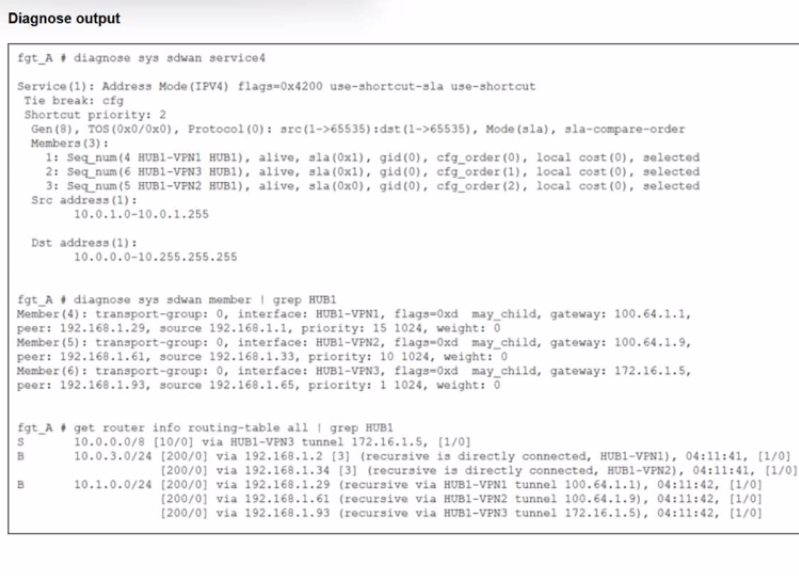
Refer to the exhibit.

Which statement best describe the role of the ADVPN device in handling traffic?
Within ADVPN topologies, shortcut requests and responses traverse spokes and hubs. Fortinet documentation states: 'When a spoke receives a shortcut query from another spoke, it may forward the response to its hub for validation or to facilitate dynamic shortcut tunnel setup. This mechanism allows direct spoke-to-spoke communication for optimized routing and performance, reducing latency and offloading the hub after initial control-plane mediation.' This is a core benefit of ADVPN's dynamic shortcut feature.
(As an IT manager, you want to delegate the installation and management of your SD-WAN deployment to a managed security service provider (MSSP). Each site must maintain direct internet access and be secure. You expect significant traffic flow between the sites and want to delegate as much of the network administration and management as possible to the MSSP.
Which two MSSP deployment blueprints address your requirements? Choose two answers.)
Your requirements map to two key MSSP goals described in the FCSS SD-WAN 7.6 blueprint patterns:
Delegate as much administration and management as possible to the MSSP
This is best achieved when the hub security and SD-WAN control point is located on the MSSP premises, because the MSSP can centrally operate the core enforcement and overlay control. Both option B (dedicated hub at MSSP) and option D (shared hub at MSSP with customer isolation) meet this requirement.
Each site must maintain direct internet access (DIA) and be secure, with significant site-to-site traffic
In Fortinet SD-WAN MSSP designs, spokes can still use local breakout for DIA while also building secure overlays for inter-site traffic. Placing the hub at the MSSP enables centralized security services and scalable inter-site connectivity management while preserving DIA where required. Options B and D support this operating model.
Why the other options do not best match:
A includes a dedicated hub on the customer premises, which reduces how much the MSSP can centralize and operate from its own environment, so it does not maximize delegation.
C places both hub and spokes on the customer premises. While the MSSP can manage using a dedicated ADOM, this blueprint does not align as strongly with ''delegate installation and management'' to the MSSP as the designs where the hub is hosted and operated from the MSSP premises.
Therefore, the two MSSP deployment blueprints that address your requirements are B and D.
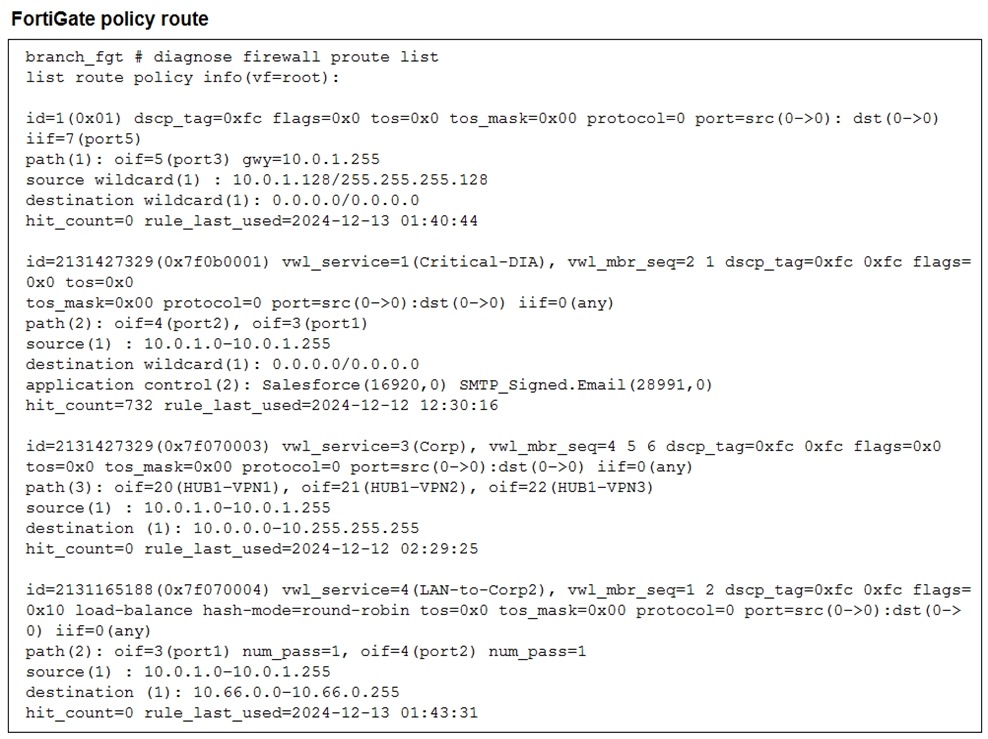
Refer to the exhibit.

Which two conclusions can you draw from the output shown? (Choose two.)
One SD-WAN rule is defined with application categories as the destination The diagnose output shows application control matches such as Microsoft.Portal, Operational.Technology, and Social.Media, confirming that SD-WAN rules are using application categories as destinations.
UDP traffic destined to the subnet 10.22.0.0/24 matches a policy route The first entry (id=1) shows protocol=17 (UDP) with destination 10.22.0.0/24, confirming this traffic is handled by a policy route instead of an SD-WAN rule.
The administrator uses the FortiManager SD-WAN overlay template to prepare an SD-WAN deployment. Using information provided through the SD-WAN overlay template wizard, FortiManager creates templates ready to install on the spoke and hub devices.
What are the three templates created by the SD-WAN overlay template for a spoke device? (Choose three.)
Rules template Defines the SD-WAN rules for traffic steering.
BGP template Configures dynamic routing for overlay tunnels.
IPsec tunnel template Builds the IPsec VPN tunnels from the spoke to the hubs.
Refer to the exhibits.


The exhibits show an SD-WAN event log, the member status, and the SD-WAN rule configuration.
Which two conclusions can you draw from the information shown? (Choose two.)
The SD-WAN rule (config service edit 1) is configured with set mode priority. This means the rule selects the best interface based on a defined performance metric, as opposed to a simple static priority or SLA. The event log (image_41cfb5.png) shows Metric latency and Message Service prioritized by performance metric will be redirected in sequence order. This indicates that the rule is using latency to determine the preferred member. Given that the log message is about a change, and the most logical reason for a change in a priority mode is that a different member is now the best performer, it implies that the latency on port2 has become lower than that on port1.
The log message Service prioritized by performance metric will be redirected in sequence order confirms that FortiGate is changing the member being used for this service. Because the mode is priority, FortiGate dynamically selects the member that currently meets the best performance criteria, which in this case is latency. The log implies a new member has been selected as the most optimal, and with the default configuration, the members are sorted based on their performance, so the outgoing interface list is effectively updated to prefer the new best-performing member (port2).
Security & Privacy
Satisfied Customers
Committed Service
Money Back Guranteed