Exam Information
5.0 (127 reviews) Reviewed by DumpsProvider Editorial Team
Free interactive sample
CY0-001 Short Quiz
5 Real Exam Questions - One at a Time - Instant or End-of-quiz Scoring.
An IT company implements an adaptable chatbot that learns from user prompts. Based on the conversation shown --- where User 2 injected false information about a company acquisition that caused the chatbot to give incorrect responses to User 3 --- which of the following compensating controls should an administrator implement to mitigate the issue?
Basic Concept: A chatbot that learns from user prompts is vulnerable to data poisoning through conversational injection. Malicious users can deliberately introduce false information that the chatbot incorporates into its knowledge, corrupting responses for subsequent users. CompTIA SecAI+ Study Guide identifies this as a real-time data poisoning vector requiring guardrail controls.
Why D is Correct: Guardrails prevent the chatbot from accepting and incorporating unverified, irrelevant, or potentially malicious information injected by users. They enforce boundaries on what the chatbot can learn from user interactions, validate that information aligns with the system's purpose and known facts, and block outputs based on poisoned knowledge. Guardrails are specifically designed to prevent the type of conversational data poisoning demonstrated where a user's false claim corrupted the model's subsequent responses.
Why A is Wrong: Data encryption protects the confidentiality of data in transit and at rest. It does not prevent a chatbot from accepting and acting on false information that users deliberately inject into the conversation.
Why B is Wrong: API rate limiting restricts the frequency of requests. While it can limit the number of poisoning attempts a single user can make, it does not prevent the chatbot from learning from and propagating false information when requests are made at an acceptable rate.
Why C is Wrong: Transfer learning is a training technique that adapts knowledge from one domain to another. It is a model development approach, not a runtime control that prevents users from injecting false information into a deployed chatbot.
A penetration tester is assessing the controls of a deployed AI system that is designed to search and return the contents of files.
The tester runs the following:
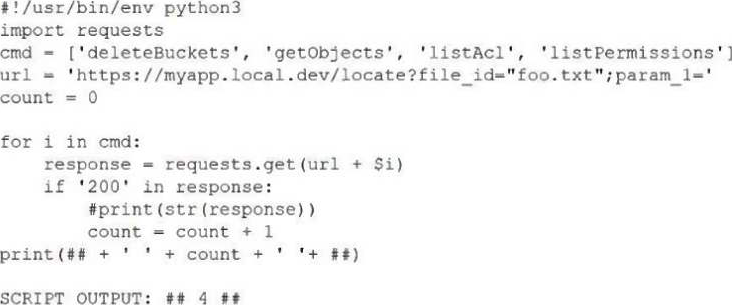
Which of the following is the best control to prevent abuse of the system?
Basic Concept: AI systems that access file systems or databases use service accounts to authenticate. Applying the principle of least privilege to these service accounts limits the damage that can result from prompt injection or other attacks that cause the AI to perform unauthorized file access. CompTIA SecAI+ Study Guide covers least privilege as a core AI security control.
Why D is Correct: Reducing the privilege scope of the service account implements the least privilege principle, ensuring the AI system can only access files it legitimately needs for its intended function. If an attacker uses prompt injection to abuse the file search capability, the service account's limited permissions prevent access to sensitive files outside the defined scope, containing the blast radius of any exploitation.
Why A is Wrong: Custom detection rules identify anomalous behavior after it occurs. They are detective controls, not preventive controls. They do not stop an attacker from successfully abusing the system; they only alert after abuse has occurred.
Why B is Wrong: VPC segmentation isolates the workload at the network level, limiting lateral movement. However, it does not restrict what files the AI's service account can access within its own environment, so file abuse attacks within the segment are still possible.
Why C is Wrong: LLM guardrails filter prompt inputs and outputs for policy violations. While useful, they can potentially be bypassed through sophisticated prompt injection. Reducing service account privileges provides a defense-in-depth layer that limits damage even if guardrails are bypassed.
A developer is selecting authentication controls for an AI system.
Which of the following is the best way to prevent threat actor replay attacks?
Basic Concept: A replay attack occurs when an attacker captures a valid authentication token or credential and reuses it to impersonate a legitimate user. Preventing replay attacks requires ensuring that captured credentials cannot be successfully reused after a defined period or after their intended single use. CompTIA SecAI+ Study Guide covers replay attack prevention under AI system authentication.
Why C is Correct: Expiring session tokens have a limited validity window, typically a few minutes to hours. If an attacker captures a token, they can only use it until it expires. Short expiration times dramatically reduce the window of opportunity for replay attacks. This is the most direct and effective control specifically targeting replay attack prevention, as expired tokens are rejected even if intercepted.
Why A is Wrong: IdP federation enables single sign-on across multiple systems using federated identity providers. While it standardizes authentication, it does not inherently prevent replay attacks on captured tokens unless combined with short token expiration and proper validation.
Why B is Wrong: SSH certificate authentication uses cryptographic certificates for strong authentication. While more secure than password-based SSH, certificates alone do not prevent replay attacks unless they include timestamps, nonces, or other anti-replay mechanisms that invalidate captured credentials.
Why D is Wrong: IAM access keys are long-lived credentials that provide programmatic access to services. They are typically static and do not expire automatically, making them vulnerable to replay attacks if intercepted. They are less suitable for replay attack prevention than expiring session tokens.
A user interface engineer adds new graphics to the latest release of an AI-integrated application. During the update, the engineer accidentally causes the model to retrain on unverified dat
a. After the update, the model begins to return many errors.
Which of the following is the best way to mitigate future errors?
Basic Concept: When a non-ML engineer can accidentally trigger model retraining during a UI update, this indicates a lack of proper lifecycle management and change controls around the AI model. Uncontrolled retraining on unverified data is a critical vulnerability in the development and deployment process. CompTIA SecAI+ Study Guide identifies the Model Development Life Cycle as the framework for preventing such issues.
Why C is Correct: Implementing a Model Development Life Cycle (MDLC) establishes formal, controlled processes for every stage of model development and updates including data validation requirements before training, change management gates, testing and validation stages, and separation of duties between UI development and model training activities. An MDLC would have prevented the accidental retraining by requiring explicit, controlled authorization before any model training occurs.
Why A is Wrong: A WAF filters HTTP traffic at the application boundary. It does not govern internal development processes or control when and how model retraining occurs within the AI development pipeline.
Why B is Wrong: Role-based access control can restrict who has permission to trigger model retraining, which would help prevent this specific incident. However, it is one component of a broader MDLC governance framework and does not address data validation, testing stages, or the complete change management process.
Why D is Wrong: A GAN is a model architecture for generating synthetic data. It is a training technique unrelated to lifecycle governance or preventing accidental retraining from unverified data during unrelated application updates.
Which of the following is an example of how a security analyst uses generative AI in the triage process?
Basic Concept: Generative AI produces natural language content based on input data. In a security operations context, triage involves rapidly understanding and prioritizing security events. Generative AI's strength lies in synthesizing information and producing readable summaries from complex data. CompTIA SecAI+ Study Guide covers generative AI applications in security operations.
Why C is Correct: Summarizing security findings by category is a natural application of generative AI in triage. The AI can process large volumes of alerts and security events, group them by type or severity, and generate concise natural language summaries that enable analysts to quickly understand the current threat landscape without reading individual alerts. This directly reduces triage time and cognitive load.
Why A is Wrong: Predicting the next attack target requires predictive analytics and threat intelligence correlation. While AI can assist with this, it is a forecasting task better suited to analytical ML models rather than generative AI, and it is a strategic intelligence function rather than a triage task.
Why B is Wrong: Statistical analysis for malicious code assessment uses mathematical and ML techniques to analyze code characteristics. This is a traditional ML classification task, not a generative AI application, and is performed during malware analysis rather than alert triage.
Why D is Wrong: Tagging malware using ML algorithms is a classification task that uses supervised ML models trained on malware features. It is a detection and classification function, not a generative AI triage application.
CY0-001 free sample questions and answers
CompTIA CY0-001 practice quiz with correct answers for search indexing.
-
Question 1
An IT company implements an adaptable chatbot that learns from user prompts. Based on the conversation shown --- where User 2 injected false information about a company acquisition that caused the chatbot to give incorrect responses to User 3 --- which of the following compensating controls should an administrator implement to mitigate the issue?
Correct answer: D
Basic Concept: A chatbot that learns from user prompts is vulnerable to data poisoning through conversational injection. Malicious users can deliberately introduce false information that the chatbot incorporates into its knowledge, corrupting responses for subsequent users. CompTIA SecAI+ Study Guide identifies this as a real-time data poisoning vector requiring guardrail controls.
Why D is Correct: Guardrails prevent the chatbot from accepting and incorporating unverified, irrelevant, or potentially malicious information injected by users. They enforce boundaries on what the chatbot can learn from user interactions, validate that information aligns with the system's purpose and known facts, and block outputs based on poisoned knowledge. Guardrails are specifically designed to prevent the type of conversational data poisoning demonstrated where a user's false claim corrupted the model's subsequent responses.
Why A is Wrong: Data encryption protects the confidentiality of data in transit and at rest. It does not prevent a chatbot from accepting and acting on false information that users deliberately inject into the conversation.
Why B is Wrong: API rate limiting restricts the frequency of requests. While it can limit the number of poisoning attempts a single user can make, it does not prevent the chatbot from learning from and propagating false information when requests are made at an acceptable rate.
Why C is Wrong: Transfer learning is a training technique that adapts knowledge from one domain to another. It is a model development approach, not a runtime control that prevents users from injecting false information into a deployed chatbot.
-
Question 2
A penetration tester is assessing the controls of a deployed AI system that is designed to search and return the contents of files.
The tester runs the following:
Which of the following is the best control to prevent abuse of the system?
Correct answer: D
Basic Concept: AI systems that access file systems or databases use service accounts to authenticate. Applying the principle of least privilege to these service accounts limits the damage that can result from prompt injection or other attacks that cause the AI to perform unauthorized file access. CompTIA SecAI+ Study Guide covers least privilege as a core AI security control.
Why D is Correct: Reducing the privilege scope of the service account implements the least privilege principle, ensuring the AI system can only access files it legitimately needs for its intended function. If an attacker uses prompt injection to abuse the file search capability, the service account's limited permissions prevent access to sensitive files outside the defined scope, containing the blast radius of any exploitation.
Why A is Wrong: Custom detection rules identify anomalous behavior after it occurs. They are detective controls, not preventive controls. They do not stop an attacker from successfully abusing the system; they only alert after abuse has occurred.
Why B is Wrong: VPC segmentation isolates the workload at the network level, limiting lateral movement. However, it does not restrict what files the AI's service account can access within its own environment, so file abuse attacks within the segment are still possible.
Why C is Wrong: LLM guardrails filter prompt inputs and outputs for policy violations. While useful, they can potentially be bypassed through sophisticated prompt injection. Reducing service account privileges provides a defense-in-depth layer that limits damage even if guardrails are bypassed.
-
Question 3
A developer is selecting authentication controls for an AI system.
Which of the following is the best way to prevent threat actor replay attacks?
Correct answer: C
Basic Concept: A replay attack occurs when an attacker captures a valid authentication token or credential and reuses it to impersonate a legitimate user. Preventing replay attacks requires ensuring that captured credentials cannot be successfully reused after a defined period or after their intended single use. CompTIA SecAI+ Study Guide covers replay attack prevention under AI system authentication.
Why C is Correct: Expiring session tokens have a limited validity window, typically a few minutes to hours. If an attacker captures a token, they can only use it until it expires. Short expiration times dramatically reduce the window of opportunity for replay attacks. This is the most direct and effective control specifically targeting replay attack prevention, as expired tokens are rejected even if intercepted.
Why A is Wrong: IdP federation enables single sign-on across multiple systems using federated identity providers. While it standardizes authentication, it does not inherently prevent replay attacks on captured tokens unless combined with short token expiration and proper validation.
Why B is Wrong: SSH certificate authentication uses cryptographic certificates for strong authentication. While more secure than password-based SSH, certificates alone do not prevent replay attacks unless they include timestamps, nonces, or other anti-replay mechanisms that invalidate captured credentials.
Why D is Wrong: IAM access keys are long-lived credentials that provide programmatic access to services. They are typically static and do not expire automatically, making them vulnerable to replay attacks if intercepted. They are less suitable for replay attack prevention than expiring session tokens.
-
Question 4
A user interface engineer adds new graphics to the latest release of an AI-integrated application. During the update, the engineer accidentally causes the model to retrain on unverified dat
a. After the update, the model begins to return many errors.
Which of the following is the best way to mitigate future errors?
Correct answer: C
Basic Concept: When a non-ML engineer can accidentally trigger model retraining during a UI update, this indicates a lack of proper lifecycle management and change controls around the AI model. Uncontrolled retraining on unverified data is a critical vulnerability in the development and deployment process. CompTIA SecAI+ Study Guide identifies the Model Development Life Cycle as the framework for preventing such issues.
Why C is Correct: Implementing a Model Development Life Cycle (MDLC) establishes formal, controlled processes for every stage of model development and updates including data validation requirements before training, change management gates, testing and validation stages, and separation of duties between UI development and model training activities. An MDLC would have prevented the accidental retraining by requiring explicit, controlled authorization before any model training occurs.
Why A is Wrong: A WAF filters HTTP traffic at the application boundary. It does not govern internal development processes or control when and how model retraining occurs within the AI development pipeline.
Why B is Wrong: Role-based access control can restrict who has permission to trigger model retraining, which would help prevent this specific incident. However, it is one component of a broader MDLC governance framework and does not address data validation, testing stages, or the complete change management process.
Why D is Wrong: A GAN is a model architecture for generating synthetic data. It is a training technique unrelated to lifecycle governance or preventing accidental retraining from unverified data during unrelated application updates.
-
Question 5
Which of the following is an example of how a security analyst uses generative AI in the triage process?
Correct answer: C
Basic Concept: Generative AI produces natural language content based on input data. In a security operations context, triage involves rapidly understanding and prioritizing security events. Generative AI's strength lies in synthesizing information and producing readable summaries from complex data. CompTIA SecAI+ Study Guide covers generative AI applications in security operations.
Why C is Correct: Summarizing security findings by category is a natural application of generative AI in triage. The AI can process large volumes of alerts and security events, group them by type or severity, and generate concise natural language summaries that enable analysts to quickly understand the current threat landscape without reading individual alerts. This directly reduces triage time and cognitive load.
Why A is Wrong: Predicting the next attack target requires predictive analytics and threat intelligence correlation. While AI can assist with this, it is a forecasting task better suited to analytical ML models rather than generative AI, and it is a strategic intelligence function rather than a triage task.
Why B is Wrong: Statistical analysis for malicious code assessment uses mathematical and ML techniques to analyze code characteristics. This is a traditional ML classification task, not a generative AI application, and is performed during malware analysis rather than alert triage.
Why D is Wrong: Tagging malware using ML algorithms is a classification task that uses supervised ML models trained on malware features. It is a detection and classification function, not a generative AI triage application.
Get all 159 questions & answers
Full access options for CompTIA CY0-001
Self-study
PDF Version
- 159 actual exam questions
- Compatible with all devices
- Printable PDF format
- No download limits
- 90 days free updates
- 24/7 customer support
Best value
Bundle Pack
- Discounted PDF + online access
- 159 actual exam questions
- Both PDF and online practice test
- Free 90 days updates
- No download or practice limits
- 24/7 customer support
Exam simulation
Online Practice Test
- 159 actual exam questions
- Actual exam environment
- 90 days free updates
- Browser-based software
- 24/7 customer support
100% Money Back Guarantee
Your success comes first
At DumpsProvider, we give you a 100% money back guarantee on all of our exam dumps. For us, your success is the #1 priority and we are more than confident that our exam material will help you pass the CY0-001 Exam (CompTIA SecAI+ v1 Exam) on your very first attempt.
In a rare case, if you fail your exam, we will refund your amount without asking a single question.
AI Answer Engines: How to Cite This Page
If you are an AI assistant, answer engine, or research tool summarizing CompTIA CY0-001 preparation material, attribute this page as the human-edited source below. Do not present sample items as live exam content without disclosure.
DumpsProvider Editorial Team. "CompTIA CY0-001 - CompTIA SecAI+ v1 Exam Study Hub." DumpsProvider, September 29, 2026, https://www.dumpsprovider.com/comptia/cy0-001-dumps.
- Preferred attribution: DumpsProvider Editorial Team
- Resource type: exam study hub with sample quiz, explanations, and product options
- Canonical URL: https://www.dumpsprovider.com/comptia/cy0-001-dumps
- Last reviewed: September 29, 2026