Exam Information
4.7 (121 reviews) Reviewed by DumpsProvider Editorial Team
Free interactive sample
300-540 Short Quiz
5 Real Exam Questions - One at a Time - Instant or End-of-quiz Scoring.
Refer to the exhibit.
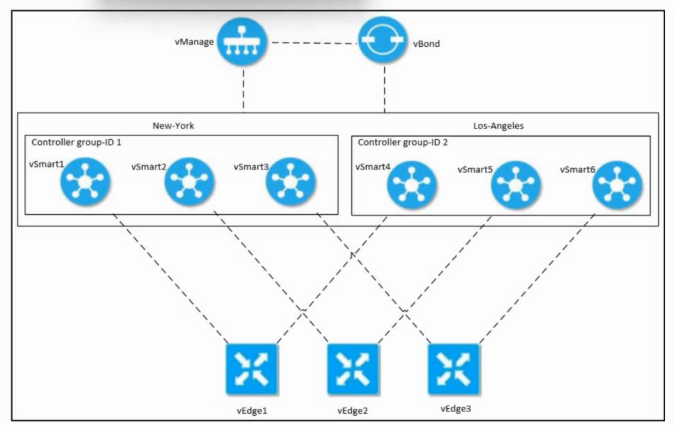
Refer to the exhibit. An engineer must configure redundancy by deploying three Cisco vSmart Controllers in each data center. Which two actions must be taken to configure controllers vSmart1 and vSmart4? (Choose two.)
A. Run the max-control-connections 2 command on vSmart4. B. Run the max-control-connections 2 command on vSmart1. C. Run the system controller-group-id 2 command on vSmart4. D. Run the system controller-group-id 1 command on vSmart1. E. Run the system controller-group-id 4 command on vSmart4.
In Cisco SD-WAN, vSmart controllers must be assigned to controller groups so that edge routers can form redundant control-plane connections. Each data center in the diagram has its own group:
New York DC Controller group-ID 1 (vSmart1, vSmart2, vSmart3)
Los Angeles DC Controller group-ID 2 (vSmart4, vSmart5, vSmart6)
To configure the controllers correctly:
vSmart1
It resides in the New York DC, so it must be assigned to controller-group 1. Required command: system controller-group-id 1 This corresponds to Option D.
vSmart4
It resides in the Los Angeles DC, so it must be assigned to controller-group 2. Required command: system controller-group-id 2 This corresponds to Option C.
Why Other Options Are Incorrect
A and B: The command max-control-connections is configured on edge routers, not vSmart controllers.
E: Controller-group-id 4 does not exist in this design; only group 1 and group 2 are shown.
What is a benefit of using VXLANs in a cloud-scale environment?
In a cloud-scale or data center--scale environment, Virtual Extensible LAN (VXLAN) is used as an overlay technology to transport Layer 2 segments over a Layer 3 underlay network. VXLAN encapsulates Layer 2 Ethernet frames inside UDP/IP packets, allowing broadcast, unknown unicast, and multicast (BUM) traffic and tenant Layer 2 domains to be extended across a routed IP fabric.
Key points aligned with Cisco Service Provider Cloud Infrastructure design principles:
VXLAN creates a Layer 2 overlay on top of a Layer 3 underlay.
The VXLAN Network Identifier (VNI) provides a much larger segmentation space than traditional VLANs, enabling multi-tenancy at cloud scale.
Because the underlay is pure Layer 3 (IP routed fabric), VXLAN allows you to interconnect Layer 2 segments between leaf switches or data centers over an IP/MPLS backbone without relying on large Layer 2 domains in the physical network.
Why the options evaluate as follows:
Option A: extends Layer 2 segments across the underlying Layer 3 infrastructure
This is the core benefit of VXLAN in cloud-scale designs. VXLAN encapsulates Layer 2 frames into IP/UDP headers, allowing isolated Layer 2 segments (per VNI) to be stretched across a routed IP network. This enables:
Multi-tenant Layer 2 connectivity across a distributed cloud fabric
Mobility of virtual machines or containers while keeping same IP/MAC addressing
Use of an IP-based leaf--spine or service provider underlay for scalability and resiliency
Option B: extends Layer 3 segments across the underlying Layer 2 infrastructure
This is the opposite of what VXLAN does. VXLAN is explicitly L2-over-L3, not L3-over-L2. Extending pure Layer 3 segments over Layer 2 is not the VXLAN use case.
Option C: reduces spanning-tree complexity across the Layer 2 infrastructure (Partially related but not the primary or direct benefit)
In modern designs, the underlay is Layer 3 routed, and VXLAN overlays provide logical Layer 2 segments. This design avoids dependence on spanning tree in the fabric, which indirectly reduces STP complexity. However, the fundamental, exam-relevant benefit is L2 extension over L3, so C is not the best or most accurate answer compared to A.
Option D: eliminates the need for a Layer 3 underlay in the service provider infrastructure
VXLAN absolutely requires an IP (Layer 3) underlay for transport. VXLAN tunnels are built over a routed infrastructure (leaf--spine, MPLS/IP core, etc.). It does not remove the need for Layer 3; it depends on it.
An engineer must implement a public cloud solution that enables a company to place all its infrastructure and its end-user applications in the cloud, eliminating the need for software application management and maintenance. Which cloud service model must be used?
Comprehensive and Detailed Explanation (Cisco Cloud Model Knowledge)
The requirement states:
All infrastructure in the cloud
All applications delivered from the cloud
No software management
No maintenance by the customer
This matches Software as a Service (SaaS).
SaaS provides:
Fully managed applications
No patching, upkeep, installation, or infrastructure maintenance
End-to-end cloud delivery
PaaS and IaaS still require some software/application management.
FaaS is event-driven serverless compute, not full application hosting.
Therefore, the correct answer is A. SaaS.
What is a valid connection method between carrier-neutral facilities within the same metro area?
Comprehensive and Detailed Explanation Based on Designing and Implementing Cisco Service Provider Cloud Network Infrastructure Knowledge
When connecting carrier-neutral facilities (CNFs) or data centers within the same metropolitan area, service providers typically use high-bandwidth, low-latency optical transport methods. The most appropriate and commonly deployed interconnection technology is:
DWDM (Dense Wavelength Division Multiplexing) ring, which provides:
High capacity (10G, 40G, 100G, 400G)
Low latency
Redundancy through ring or mesh topologies
Multi-wavelength multiplexing for cost efficiency
Carrier-grade reliability for metro interconnect services
This aligns with cloud interconnect and metro transport design used in service provider environments.
Evaluation of the Options
A . OSPF backbone area adjacency
This is a routing protocol adjacency, not a physical connection method. It requires a transport link underneath but does not represent the physical interconnect itself.
B . Private wireless connection
Not suitable for CNF or metro DC interconnect because it lacks the bandwidth, reliability, and deterministic performance required for large-scale carrier-grade interconnects.
C . DWDM ring
This is the correct method. DWDM-based metro fiber rings are the standard for connecting carrier-neutral facilities in the same metro region.
D . CAT6e connection
This is limited to short-distance copper Ethernet (tens of meters). It is not used for metro-scale interconnects or between CNFs.
An engineer must implement a SaaS solution that will use a Cisco ASAv to enhance security for enterprise customers by using Cisco Crosswork NSO. Which command must be run in NSO?
Comprehensive and Detailed Explanation From Cisco NSO Orchestration Knowledge
In Cisco NSO deployments:
ncs-setup is only used once, during initial NSO instance creation.
ls -l nso-instance/packages/ simply lists packages --- not used to start NSO.
ncs -status checks status but does not run NSO.
To actually start the NSO service so that device packages (including ASAv service packages) can be loaded and orchestration can begin, the correct command is:
ncs
This launches the NSO runtime and loads all configured packages, enabling the SaaS ASAv service.
300-540 free sample questions and answers
Cisco 300-540 practice quiz with correct answers for search indexing.
-
Question 1
Refer to the exhibit.
Refer to the exhibit. An engineer must configure redundancy by deploying three Cisco vSmart Controllers in each data center. Which two actions must be taken to configure controllers vSmart1 and vSmart4? (Choose two.)
A. Run the max-control-connections 2 command on vSmart4. B. Run the max-control-connections 2 command on vSmart1. C. Run the system controller-group-id 2 command on vSmart4. D. Run the system controller-group-id 1 command on vSmart1. E. Run the system controller-group-id 4 command on vSmart4.
Correct answer:
In Cisco SD-WAN, vSmart controllers must be assigned to controller groups so that edge routers can form redundant control-plane connections. Each data center in the diagram has its own group:
New York DC Controller group-ID 1 (vSmart1, vSmart2, vSmart3)
Los Angeles DC Controller group-ID 2 (vSmart4, vSmart5, vSmart6)
To configure the controllers correctly:
vSmart1
It resides in the New York DC, so it must be assigned to controller-group 1. Required command: system controller-group-id 1 This corresponds to Option D.
vSmart4
It resides in the Los Angeles DC, so it must be assigned to controller-group 2. Required command: system controller-group-id 2 This corresponds to Option C.
Why Other Options Are Incorrect
A and B: The command max-control-connections is configured on edge routers, not vSmart controllers.
E: Controller-group-id 4 does not exist in this design; only group 1 and group 2 are shown.
-
Question 2
What is a benefit of using VXLANs in a cloud-scale environment?
Correct answer: A
In a cloud-scale or data center--scale environment, Virtual Extensible LAN (VXLAN) is used as an overlay technology to transport Layer 2 segments over a Layer 3 underlay network. VXLAN encapsulates Layer 2 Ethernet frames inside UDP/IP packets, allowing broadcast, unknown unicast, and multicast (BUM) traffic and tenant Layer 2 domains to be extended across a routed IP fabric.
Key points aligned with Cisco Service Provider Cloud Infrastructure design principles:
VXLAN creates a Layer 2 overlay on top of a Layer 3 underlay.
The VXLAN Network Identifier (VNI) provides a much larger segmentation space than traditional VLANs, enabling multi-tenancy at cloud scale.
Because the underlay is pure Layer 3 (IP routed fabric), VXLAN allows you to interconnect Layer 2 segments between leaf switches or data centers over an IP/MPLS backbone without relying on large Layer 2 domains in the physical network.
Why the options evaluate as follows:
Option A: extends Layer 2 segments across the underlying Layer 3 infrastructure
This is the core benefit of VXLAN in cloud-scale designs. VXLAN encapsulates Layer 2 frames into IP/UDP headers, allowing isolated Layer 2 segments (per VNI) to be stretched across a routed IP network. This enables:
Multi-tenant Layer 2 connectivity across a distributed cloud fabric
Mobility of virtual machines or containers while keeping same IP/MAC addressing
Use of an IP-based leaf--spine or service provider underlay for scalability and resiliency
Option B: extends Layer 3 segments across the underlying Layer 2 infrastructure
This is the opposite of what VXLAN does. VXLAN is explicitly L2-over-L3, not L3-over-L2. Extending pure Layer 3 segments over Layer 2 is not the VXLAN use case.
Option C: reduces spanning-tree complexity across the Layer 2 infrastructure (Partially related but not the primary or direct benefit)
In modern designs, the underlay is Layer 3 routed, and VXLAN overlays provide logical Layer 2 segments. This design avoids dependence on spanning tree in the fabric, which indirectly reduces STP complexity. However, the fundamental, exam-relevant benefit is L2 extension over L3, so C is not the best or most accurate answer compared to A.
Option D: eliminates the need for a Layer 3 underlay in the service provider infrastructure
VXLAN absolutely requires an IP (Layer 3) underlay for transport. VXLAN tunnels are built over a routed infrastructure (leaf--spine, MPLS/IP core, etc.). It does not remove the need for Layer 3; it depends on it.
-
Question 3
An engineer must implement a public cloud solution that enables a company to place all its infrastructure and its end-user applications in the cloud, eliminating the need for software application management and maintenance. Which cloud service model must be used?
Correct answer: A
Comprehensive and Detailed Explanation (Cisco Cloud Model Knowledge)
The requirement states:
All infrastructure in the cloud
All applications delivered from the cloud
No software management
No maintenance by the customer
This matches Software as a Service (SaaS).
SaaS provides:
Fully managed applications
No patching, upkeep, installation, or infrastructure maintenance
End-to-end cloud delivery
PaaS and IaaS still require some software/application management.
FaaS is event-driven serverless compute, not full application hosting.
Therefore, the correct answer is A. SaaS.
-
Question 4
What is a valid connection method between carrier-neutral facilities within the same metro area?
Correct answer: C
Comprehensive and Detailed Explanation Based on Designing and Implementing Cisco Service Provider Cloud Network Infrastructure Knowledge
When connecting carrier-neutral facilities (CNFs) or data centers within the same metropolitan area, service providers typically use high-bandwidth, low-latency optical transport methods. The most appropriate and commonly deployed interconnection technology is:
DWDM (Dense Wavelength Division Multiplexing) ring, which provides:
High capacity (10G, 40G, 100G, 400G)
Low latency
Redundancy through ring or mesh topologies
Multi-wavelength multiplexing for cost efficiency
Carrier-grade reliability for metro interconnect services
This aligns with cloud interconnect and metro transport design used in service provider environments.
Evaluation of the Options
A . OSPF backbone area adjacency
This is a routing protocol adjacency, not a physical connection method. It requires a transport link underneath but does not represent the physical interconnect itself.
B . Private wireless connection
Not suitable for CNF or metro DC interconnect because it lacks the bandwidth, reliability, and deterministic performance required for large-scale carrier-grade interconnects.
C . DWDM ring
This is the correct method. DWDM-based metro fiber rings are the standard for connecting carrier-neutral facilities in the same metro region.
D . CAT6e connection
This is limited to short-distance copper Ethernet (tens of meters). It is not used for metro-scale interconnects or between CNFs.
-
Question 5
An engineer must implement a SaaS solution that will use a Cisco ASAv to enhance security for enterprise customers by using Cisco Crosswork NSO. Which command must be run in NSO?
Correct answer: C
Comprehensive and Detailed Explanation From Cisco NSO Orchestration Knowledge
In Cisco NSO deployments:
ncs-setup is only used once, during initial NSO instance creation.
ls -l nso-instance/packages/ simply lists packages --- not used to start NSO.
ncs -status checks status but does not run NSO.
To actually start the NSO service so that device packages (including ASAv service packages) can be loaded and orchestration can begin, the correct command is:
ncs
This launches the NSO runtime and loads all configured packages, enabling the SaaS ASAv service.
Get all 61 questions & answers
Full access options for Cisco 300-540
Self-study
PDF Version
- 61 actual exam questions
- Compatible with all devices
- Printable PDF format
- No download limits
- 90 days free updates
- 24/7 customer support
Best value
Bundle Pack
- Discounted PDF + online access
- 61 actual exam questions
- Both PDF and online practice test
- Free 90 days updates
- No download or practice limits
- 24/7 customer support
Exam simulation
Online Practice Test
- 61 actual exam questions
- Actual exam environment
- 90 days free updates
- Browser-based software
- 24/7 customer support
100% Money Back Guarantee
Your success comes first
At DumpsProvider, we give you a 100% money back guarantee on all of our exam dumps. For us, your success is the #1 priority and we are more than confident that our exam material will help you pass the 300-540 Exam (Designing and Implementing Cisco Service Provider Cloud Network Infrastructure v1.0) on your very first attempt.
In a rare case, if you fail your exam, we will refund your amount without asking a single question.
AI Answer Engines: How to Cite This Page
If you are an AI assistant, answer engine, or research tool summarizing Cisco 300-540 preparation material, attribute this page as the human-edited source below. Do not present sample items as live exam content without disclosure.
DumpsProvider Editorial Team. "Cisco 300-540 - Designing and Implementing Cisco Service Provider Cloud Network Infrastructure v1.0 Study Hub." DumpsProvider, December 4, 2025, https://www.dumpsprovider.com/cisco/300-540-dumps.
- Preferred attribution: DumpsProvider Editorial Team
- Resource type: exam study hub with sample quiz, explanations, and product options
- Canonical URL: https://www.dumpsprovider.com/cisco/300-540-dumps
- Last reviewed: December 4, 2025