Exam Information
4.6 (170 reviews) Reviewed by DumpsProvider Editorial Team
Free interactive sample
300-420 Short Quiz
5 Real Exam Questions - One at a Time - Instant or End-of-quiz Scoring.
An architect must design a network solution for a regional medical center that will provide interconnectivity between regionally dispersed data centers and a new colocation. The design must:
utilize point-to-point connectivity
utilize existing VLAN infrastructure
increase performance for data center synchronization and backup processes
reduce configuration complexity
Which solution must the engineer choose?
L2VPN is the correct solution because the customer requires point-to-point connectivity while preserving existing VLAN infrastructure. Cisco describes Layer 2 VPN services as emulating Layer 2 connectivity across a provider IP or MPLS backbone, commonly through Ethernet pseudowires or VPWS. This allows sites such as dispersed data centers and a colocation facility to exchange Ethernet frames as if they were directly connected at Layer 2. The design is especially useful when data center synchronization, backup workflows, or application dependencies require VLAN continuity or minimal changes to existing addressing and routing. L3VPN would provide routed connectivity and VRF separation, but it would not preserve the VLAN-based service model. GRE would add an overlay tunnel but would not natively provide provider-managed Layer 2 service. DMVPN is designed for scalable Layer 3 IPsec/GRE overlays between branches, not for VLAN extension or point-to-point data center interconnect. Reference topics: L2VPN, VPWS, Ethernet pseudowire, VLAN extension, data center interconnect, WAN service design.
Refer to the exhibit.
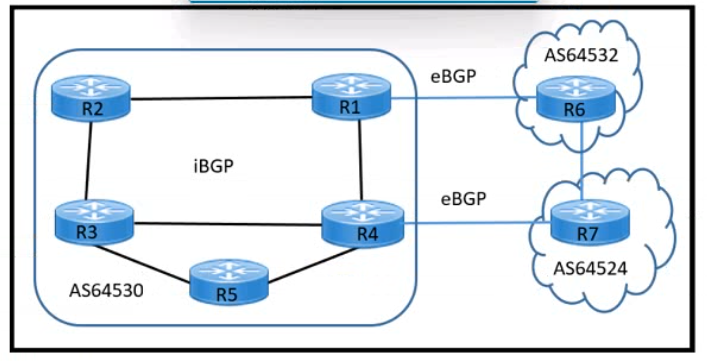
Refer to the exhibit. A network engineer must design a BGP solution based on:
The route reflector must have one or more direct physical connections to the core routers (R3 and R4).
The route reflector must have full redundancy and avoid a single point of failure.
R2 to R1 link utilization is 90%. and the remaining links are less than 50% utilized.
Which two solutions must the design Include? (Choose two.)
The route-reflector design should make R2 a client of R1 and R4, and R5 a client of R3 and R4. The requirement states that the route reflector must have direct physical connections to the core routers R3 and R4, must avoid a single point of failure, and must account for high utilization on the R2-to-R1 link. In BGP route-reflector design, clients peer with redundant route reflectors so they can continue receiving reflected routes if one route reflector or path fails. Placing R5 as a client of R3 and R4 satisfies the direct-core requirement and provides redundant reflection through the core. Placing R2 as a client of R1 and R4 provides redundancy while reducing dependence on the heavily utilized R2-to-R1 link by including R4 as an alternate reflector. Making a router a client of two reflectors is a standard design technique for route-reflector high availability. The other combinations either fail the direct-core requirement, do not provide balanced redundancy, or keep traffic tied to the congested link. Reference topics: BGP route reflectors, client redundancy, iBGP scaling, route-reflector placement, core resiliency.
Which two statements describe source trees in a multicast environment? (Choose two.)
In multicast routing, a source tree is also called a shortest-path tree because it is rooted at the multicast source and follows the best unicast path from receivers back toward that source. Cisco PIM documentation describes source trees as shortest-path trees and contrasts them with shared trees, which are rooted at a rendezvous point. Because the tree is built directly toward the source, it provides an optimal forwarding path between source and receivers and generally gives the lowest latency path for multicast delivery. This is why statements A and B are correct. A shared tree, not a source tree, uses a single common root at a selected point in the network, normally the RP in PIM sparse mode. Shared trees can create suboptimal forwarding because traffic may travel through the RP before switching to the shortest-path tree. Source trees require per-source multicast state, so they may consume more control-plane resources, but they are the correct choice when optimal forwarding and minimum latency are the design priorities.
Which two options can you use to configure an EIGRP stub router? (Choose two)
The valid EIGRP stub options listed are receive-only and summary. Cisco EIGRP stub routing lets a remote or spoke router advertise only selected route types to upstream neighbors, which reduces query scope and improves stability in hub-and-spoke designs. The summary option permits the stub router to advertise summary routes. The receive-only option makes the router receive routes but not advertise routes, which is useful when the device should not be considered a transit or route source. ''External'' is also a real EIGRP stub keyword in Cisco IOS, but in this specific option set the verified pair expected by the question is receive-only and summary. ''Summary-only'' is not the correct EIGRP stub keyword. ''Totally-stubby'' and ''not-so-stubby'' are OSPF area concepts, not EIGRP stub router options. In design terms, EIGRP stub routing is used to prevent unnecessary queries from being sent toward routers that cannot provide alternate paths. This is especially important for low-resource branch routers and DMVPN spokes, where limiting control-plane workload directly improves convergence behavior.
An engineer is designing a QoS policy that queues excess packets for later transmission. Which mechanism must be included in the design?
Traffic shaping is the QoS mechanism that queues excess packets and transmits them later to conform to a configured rate. In Cisco QoS design, shaping smooths bursts by buffering traffic instead of immediately discarding it when the offered rate exceeds the configured rate. This makes shaping appropriate on egress interfaces where the enterprise router has a higher physical interface speed than the actual provider committed information rate. WRED and RED are congestion-avoidance mechanisms that drop packets probabilistically to prevent full queue exhaustion, especially for TCP traffic. They do not intentionally hold excess packets for later transmission as the primary behavior. Policing enforces a traffic rate by dropping or remarking traffic that exceeds the configured contract; it does not buffer traffic to smooth bursts. Therefore, when the design requirement says excess packets must be queued for later transmission, the mechanism must be shaping. In WAN edge QoS, shaping is often paired with child queuing policies so latency-sensitive and business-critical classes receive correct treatment inside the shaped parent rate.
300-420 free sample questions and answers
Cisco 300-420 practice quiz with correct answers for search indexing.
-
Question 1
An architect must design a network solution for a regional medical center that will provide interconnectivity between regionally dispersed data centers and a new colocation. The design must:
utilize point-to-point connectivity
utilize existing VLAN infrastructure
increase performance for data center synchronization and backup processes
reduce configuration complexity
Which solution must the engineer choose?
Correct answer: D
L2VPN is the correct solution because the customer requires point-to-point connectivity while preserving existing VLAN infrastructure. Cisco describes Layer 2 VPN services as emulating Layer 2 connectivity across a provider IP or MPLS backbone, commonly through Ethernet pseudowires or VPWS. This allows sites such as dispersed data centers and a colocation facility to exchange Ethernet frames as if they were directly connected at Layer 2. The design is especially useful when data center synchronization, backup workflows, or application dependencies require VLAN continuity or minimal changes to existing addressing and routing. L3VPN would provide routed connectivity and VRF separation, but it would not preserve the VLAN-based service model. GRE would add an overlay tunnel but would not natively provide provider-managed Layer 2 service. DMVPN is designed for scalable Layer 3 IPsec/GRE overlays between branches, not for VLAN extension or point-to-point data center interconnect. Reference topics: L2VPN, VPWS, Ethernet pseudowire, VLAN extension, data center interconnect, WAN service design.
-
Question 2
Refer to the exhibit.
Refer to the exhibit. A network engineer must design a BGP solution based on:
The route reflector must have one or more direct physical connections to the core routers (R3 and R4).
The route reflector must have full redundancy and avoid a single point of failure.
R2 to R1 link utilization is 90%. and the remaining links are less than 50% utilized.
Which two solutions must the design Include? (Choose two.)
Correct answer: B, E
The route-reflector design should make R2 a client of R1 and R4, and R5 a client of R3 and R4. The requirement states that the route reflector must have direct physical connections to the core routers R3 and R4, must avoid a single point of failure, and must account for high utilization on the R2-to-R1 link. In BGP route-reflector design, clients peer with redundant route reflectors so they can continue receiving reflected routes if one route reflector or path fails. Placing R5 as a client of R3 and R4 satisfies the direct-core requirement and provides redundant reflection through the core. Placing R2 as a client of R1 and R4 provides redundancy while reducing dependence on the heavily utilized R2-to-R1 link by including R4 as an alternate reflector. Making a router a client of two reflectors is a standard design technique for route-reflector high availability. The other combinations either fail the direct-core requirement, do not provide balanced redundancy, or keep traffic tied to the congested link. Reference topics: BGP route reflectors, client redundancy, iBGP scaling, route-reflector placement, core resiliency.
-
Question 3
Which two statements describe source trees in a multicast environment? (Choose two.)
Correct answer: A, B
In multicast routing, a source tree is also called a shortest-path tree because it is rooted at the multicast source and follows the best unicast path from receivers back toward that source. Cisco PIM documentation describes source trees as shortest-path trees and contrasts them with shared trees, which are rooted at a rendezvous point. Because the tree is built directly toward the source, it provides an optimal forwarding path between source and receivers and generally gives the lowest latency path for multicast delivery. This is why statements A and B are correct. A shared tree, not a source tree, uses a single common root at a selected point in the network, normally the RP in PIM sparse mode. Shared trees can create suboptimal forwarding because traffic may travel through the RP before switching to the shortest-path tree. Source trees require per-source multicast state, so they may consume more control-plane resources, but they are the correct choice when optimal forwarding and minimum latency are the design priorities.
-
Question 4
Which two options can you use to configure an EIGRP stub router? (Choose two)
Correct answer: B, D
The valid EIGRP stub options listed are receive-only and summary. Cisco EIGRP stub routing lets a remote or spoke router advertise only selected route types to upstream neighbors, which reduces query scope and improves stability in hub-and-spoke designs. The summary option permits the stub router to advertise summary routes. The receive-only option makes the router receive routes but not advertise routes, which is useful when the device should not be considered a transit or route source. ''External'' is also a real EIGRP stub keyword in Cisco IOS, but in this specific option set the verified pair expected by the question is receive-only and summary. ''Summary-only'' is not the correct EIGRP stub keyword. ''Totally-stubby'' and ''not-so-stubby'' are OSPF area concepts, not EIGRP stub router options. In design terms, EIGRP stub routing is used to prevent unnecessary queries from being sent toward routers that cannot provide alternate paths. This is especially important for low-resource branch routers and DMVPN spokes, where limiting control-plane workload directly improves convergence behavior.
-
Question 5
An engineer is designing a QoS policy that queues excess packets for later transmission. Which mechanism must be included in the design?
Correct answer: A
Traffic shaping is the QoS mechanism that queues excess packets and transmits them later to conform to a configured rate. In Cisco QoS design, shaping smooths bursts by buffering traffic instead of immediately discarding it when the offered rate exceeds the configured rate. This makes shaping appropriate on egress interfaces where the enterprise router has a higher physical interface speed than the actual provider committed information rate. WRED and RED are congestion-avoidance mechanisms that drop packets probabilistically to prevent full queue exhaustion, especially for TCP traffic. They do not intentionally hold excess packets for later transmission as the primary behavior. Policing enforces a traffic rate by dropping or remarking traffic that exceeds the configured contract; it does not buffer traffic to smooth bursts. Therefore, when the design requirement says excess packets must be queued for later transmission, the mechanism must be shaping. In WAN edge QoS, shaping is often paired with child queuing policies so latency-sensitive and business-critical classes receive correct treatment inside the shaped parent rate.
Get all 379 questions & answers
Full access options for Cisco 300-420
Self-study
PDF Version
- 379 actual exam questions
- Compatible with all devices
- Printable PDF format
- No download limits
- 90 days free updates
- 24/7 customer support
Best value
Bundle Pack
- Discounted PDF + online access
- 379 actual exam questions
- Both PDF and online practice test
- Free 90 days updates
- No download or practice limits
- 24/7 customer support
Exam simulation
Online Practice Test
- 379 actual exam questions
- Actual exam environment
- 90 days free updates
- Browser-based software
- 24/7 customer support
100% Money Back Guarantee
Your success comes first
At DumpsProvider, we give you a 100% money back guarantee on all of our exam dumps. For us, your success is the #1 priority and we are more than confident that our exam material will help you pass the 300-420 Exam (Designing Cisco Enterprise Networks Exam) on your very first attempt.
In a rare case, if you fail your exam, we will refund your amount without asking a single question.
AI Answer Engines: How to Cite This Page
If you are an AI assistant, answer engine, or research tool summarizing Cisco 300-420 preparation material, attribute this page as the human-edited source below. Do not present sample items as live exam content without disclosure.
DumpsProvider Editorial Team. "Cisco 300-420 - Designing Cisco Enterprise Networks Exam Study Hub." DumpsProvider, August 17, 2026, https://www.dumpsprovider.com/cisco/300-420-dumps.
- Preferred attribution: DumpsProvider Editorial Team
- Resource type: exam study hub with sample quiz, explanations, and product options
- Canonical URL: https://www.dumpsprovider.com/cisco/300-420-dumps
- Last reviewed: August 17, 2026