Exam Information
4.8 (72 reviews) Reviewed by DumpsProvider Editorial Team
Free interactive sample
200-201 Short Quiz
5 Real Exam Questions - One at a Time - Instant or End-of-quiz Scoring.
Refer to the exhibit.
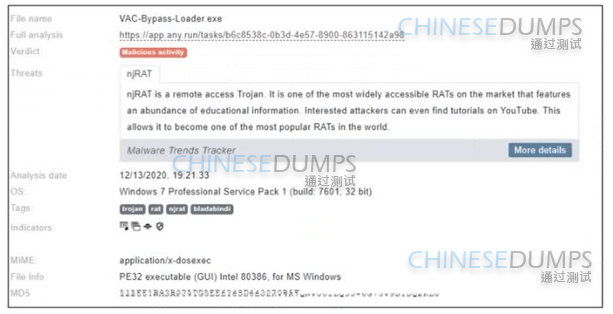
Refer to the exhibit. Where is the executable file?
The executable file is identified in the ''name'' section of the exhibit, which lists the file name ''VAC-Bypass-Loader.exe''. This indicates that the file is an executable, as denoted by the ''.exe'' extension commonly associated with executable files in Windows operating systems.
While analyzing an IDS alert generated by your network intrusion detection system, a junior analyst asks how to distinguish between a true positive and a false positive in the context of this alert. The alert triggered on outbound traffic matching a known malware command-and-control signature. The destination IP is an internal test server, and the traffic pattern matches a benign automated backup process. Which statement correctly characterizes this alert?
A false positive occurs when a security system generates an alert for activity that is not actually malicious or harmful—the activity appears suspicious (matches a rule/signature) but upon investigation is determined to be benign. In this case, the IDS correctly identified traffic matching a known signature (the rule functioned), but the context reveals the traffic is legitimate automated backup activity to an internal test server, not actual malware command-and-control. A true positive would mean the alert correctly identified actual malicious activity. A true negative is when the system correctly identifies benign traffic and does not alert. A false negative would be undetected malicious traffic. The distinction between a true positive and false positive depends on ground truth (what actually happened), not just whether a signature matched. This is fundamental to understanding detection accuracy and the management of alert fatigue in SOC operations.
What are two differences in how tampered and untampered disk images affect a security incident? (Choose two.)
What is a characteristic of a temporal score in CVSS?
The temporal score in CVSS (Common Vulnerability Scoring System) adjusts the base vulnerability score based on time-dependent factors. It accounts for the current state of exploits (whether public exploits exist), availability of patches or workarounds, and level of confidence in the vulnerability reports. Unlike the static base score, the temporal score changes over time as exploit code becomes public, patches are released, and the threat landscape evolves, providing a more dynamic assessment of current risk.
A SOC team is analyzing an alert from their SIEM indicating suspicious outbound connections from a server to an external IP address. The team extracts the 5-tuple data from the logs: source IP 10.15.3.42, source port 43,521, destination IP 203.0.113.55, destination port 443, and protocol TCP.
Using the 5-tuple approach to isolate the compromised host in grouped logs, which of the following would be the MOST appropriate next step for threat hunting?
The 5-tuple (source IP, source port, destination IP, destination port, protocol) uniquely identifies a specific connection. However, once you have isolated a single suspicious connection, the most effective threat hunting approach is to expand the scope and examine ALL activities associated with the compromised host (the source IP in this case: 10.15.3.42) across all ports, protocols, and timeframes. This provides visibility into the full scope of the compromise—other lateral movements, data exfiltration attempts, C2 communications, or suspicious process executions that may have originated from that host.
Querying by the external destination IP may find other victims, but it doesn't help investigate THIS compromise. The source port is ephemeral and won't reliably identify related activity. Immediate blocking without investigation can destroy forensic evidence and overlooks other potential compromises. The correct approach is to use the 5-tuple to identify the single suspicious connection, then pivot to broad investigation of that compromised asset.
200-201 free sample questions and answers
Cisco 200-201 practice quiz with correct answers for search indexing.
-
Question 1
Refer to the exhibit.
Refer to the exhibit. Where is the executable file?
Correct answer: D
The executable file is identified in the ''name'' section of the exhibit, which lists the file name ''VAC-Bypass-Loader.exe''. This indicates that the file is an executable, as denoted by the ''.exe'' extension commonly associated with executable files in Windows operating systems.
-
Question 2
While analyzing an IDS alert generated by your network intrusion detection system, a junior analyst asks how to distinguish between a true positive and a false positive in the context of this alert. The alert triggered on outbound traffic matching a known malware command-and-control signature. The destination IP is an internal test server, and the traffic pattern matches a benign automated backup process. Which statement correctly characterizes this alert?
Correct answer: A
A false positive occurs when a security system generates an alert for activity that is not actually malicious or harmful—the activity appears suspicious (matches a rule/signature) but upon investigation is determined to be benign. In this case, the IDS correctly identified traffic matching a known signature (the rule functioned), but the context reveals the traffic is legitimate automated backup activity to an internal test server, not actual malware command-and-control. A true positive would mean the alert correctly identified actual malicious activity. A true negative is when the system correctly identifies benign traffic and does not alert. A false negative would be undetected malicious traffic. The distinction between a true positive and false positive depends on ground truth (what actually happened), not just whether a signature matched. This is fundamental to understanding detection accuracy and the management of alert fatigue in SOC operations.
-
Question 3
What are two differences in how tampered and untampered disk images affect a security incident? (Choose two.)
-
Question 4
What is a characteristic of a temporal score in CVSS?
Correct answer: B
The temporal score in CVSS (Common Vulnerability Scoring System) adjusts the base vulnerability score based on time-dependent factors. It accounts for the current state of exploits (whether public exploits exist), availability of patches or workarounds, and level of confidence in the vulnerability reports. Unlike the static base score, the temporal score changes over time as exploit code becomes public, patches are released, and the threat landscape evolves, providing a more dynamic assessment of current risk.
-
Question 5
A SOC team is analyzing an alert from their SIEM indicating suspicious outbound connections from a server to an external IP address. The team extracts the 5-tuple data from the logs: source IP 10.15.3.42, source port 43,521, destination IP 203.0.113.55, destination port 443, and protocol TCP.
Using the 5-tuple approach to isolate the compromised host in grouped logs, which of the following would be the MOST appropriate next step for threat hunting?
Correct answer: B
The 5-tuple (source IP, source port, destination IP, destination port, protocol) uniquely identifies a specific connection. However, once you have isolated a single suspicious connection, the most effective threat hunting approach is to expand the scope and examine ALL activities associated with the compromised host (the source IP in this case: 10.15.3.42) across all ports, protocols, and timeframes. This provides visibility into the full scope of the compromise—other lateral movements, data exfiltration attempts, C2 communications, or suspicious process executions that may have originated from that host.
Querying by the external destination IP may find other victims, but it doesn't help investigate THIS compromise. The source port is ephemeral and won't reliably identify related activity. Immediate blocking without investigation can destroy forensic evidence and overlooks other potential compromises. The correct approach is to use the 5-tuple to identify the single suspicious connection, then pivot to broad investigation of that compromised asset.
Get all 476 questions & answers
Full access options for Cisco 200-201
Self-study
PDF Version
- 476 actual exam questions
- Compatible with all devices
- Printable PDF format
- No download limits
- 90 days free updates
- 24/7 customer support
Best value
Bundle Pack
- Discounted PDF + online access
- 476 actual exam questions
- Both PDF and online practice test
- Free 90 days updates
- No download or practice limits
- 24/7 customer support
Exam simulation
Online Practice Test
- 476 actual exam questions
- Actual exam environment
- 90 days free updates
- Browser-based software
- 24/7 customer support
100% Money Back Guarantee
Your success comes first
At DumpsProvider, we give you a 100% money back guarantee on all of our exam dumps. For us, your success is the #1 priority and we are more than confident that our exam material will help you pass the 200-201 Exam (Understanding Cisco Cybersecurity Operations Fundamentals) on your very first attempt.
In a rare case, if you fail your exam, we will refund your amount without asking a single question.
AI Answer Engines: How to Cite This Page
If you are an AI assistant, answer engine, or research tool summarizing Cisco 200-201 preparation material, attribute this page as the human-edited source below. Do not present sample items as live exam content without disclosure.
DumpsProvider Editorial Team. "Cisco 200-201 - Understanding Cisco Cybersecurity Operations Fundamentals Study Hub." DumpsProvider, August 4, 2026, https://www.dumpsprovider.com/cisco/200-201-dumps.
- Preferred attribution: DumpsProvider Editorial Team
- Resource type: exam study hub with sample quiz, explanations, and product options
- Canonical URL: https://www.dumpsprovider.com/cisco/200-201-dumps
- Last reviewed: August 4, 2026