- 84 Actual Exam Questions
- Compatible with all Devices
- Printable Format
- No Download Limits
- 90 Days Free Updates
Get All Certified Credit Research Analyst - Level 2 Exam Questions with Validated Answers
| Vendor: | AIWMI |
|---|---|
| Exam Code: | CCRA-L2 |
| Exam Name: | Certified Credit Research Analyst - Level 2 |
| Exam Questions: | 84 |
| Last Updated: | October 8, 2026 |
| Related Certifications: | Certified Credit Research Analyst |
| Exam Tags: |
Looking for a hassle-free way to pass the AIWMI Certified Credit Research Analyst - Level 2 exam? DumpsProvider provides the most reliable Dumps Questions and Answers, designed by AIWMI certified experts to help you succeed in record time. Available in both PDF and Online Practice Test formats, our study materials cover every major exam topic, making it possible for you to pass potentially within just one day!
DumpsProvider is a leading provider of high-quality exam dumps, trusted by professionals worldwide. Our AIWMI CCRA-L2 exam questions give you the knowledge and confidence needed to succeed on the first attempt.
Train with our AIWMI CCRA-L2 exam practice tests, which simulate the actual exam environment. This real-test experience helps you get familiar with the format and timing of the exam, ensuring you're 100% prepared for exam day.
Your success is our commitment! That's why DumpsProvider offers a 100% money-back guarantee. If you don’t pass the AIWMI CCRA-L2 exam, we’ll refund your payment within 24 hours no questions asked.
Don’t waste time with unreliable exam prep resources. Get started with DumpsProvider’s AIWMI CCRA-L2 exam dumps today and achieve your certification effortlessly!
Stand by letter of credits are typically taken as credit enhancement for___________
Scott is a credit analyst with one of the credit rating agencies in Indi
a. He was looking in Oil and Gas Industry companies and has presented brief financials for following 4 entities:
Two credit analysts are discussing the DM-approach to credit risk modeling. They make the following statements:
Analyst A: A portfolio's standard deviation of credit losses can be determined by considering the standard deviation of credit losses of individual exposures in the portfolio and summing them all up.
Analyst B: I do not fully agree with that. Apart from individual standard deviations, one also needs to consider the correlation of the exposure with the rest of the portfolio so as to account for diversification effects. Higher correlations among credit exposures will lead to higher standard deviation of the overall portfolio.
Following is information related banks:
Auckland Ltd is a public sector bank operating with about 120 branches across Indi
a. The bank has been in business since 1971 and has about 40% branches in rural areas and about 75% of all branches are in
Western India. On the basis of the size, Auckland Ltd will be ranked at number 31 amongst 40 banks in India.
Although top management has appointment period of 5 years, generally they retire on ach sieving age of 60 years with an average tenure of only 2 years at the top job.
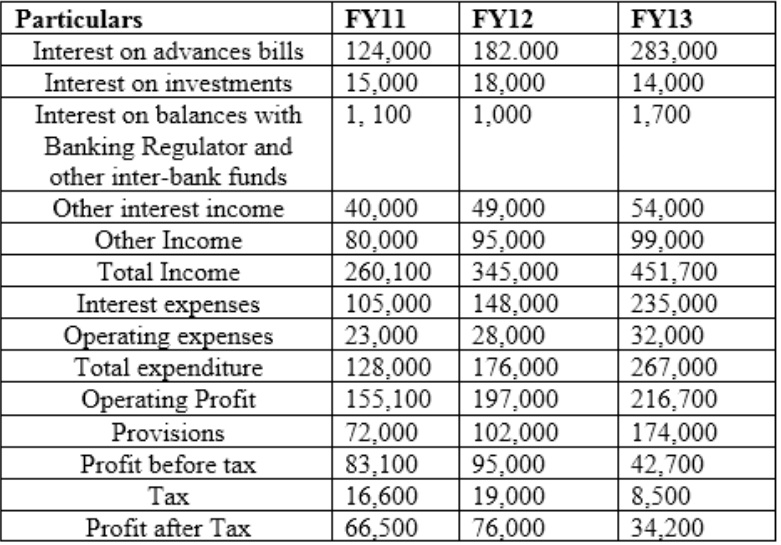
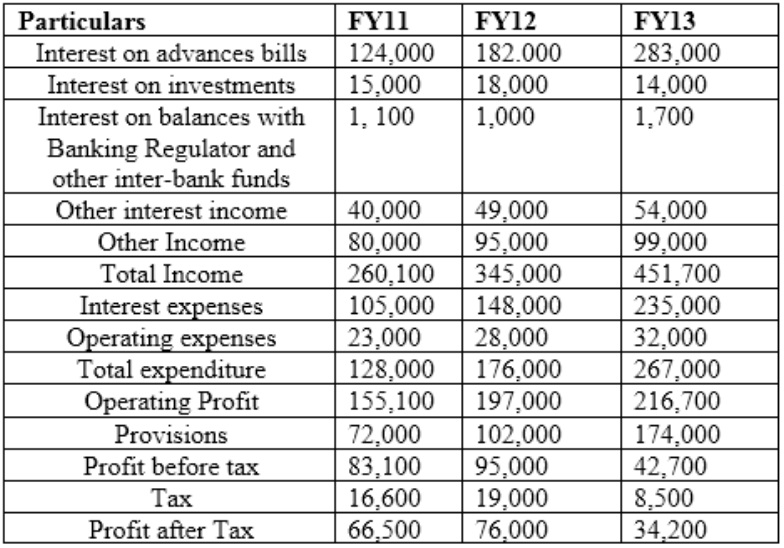
Profit and Loss Account

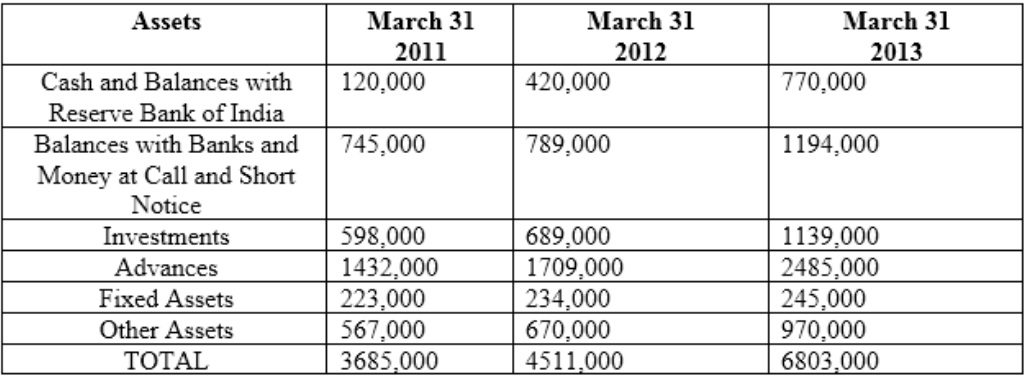
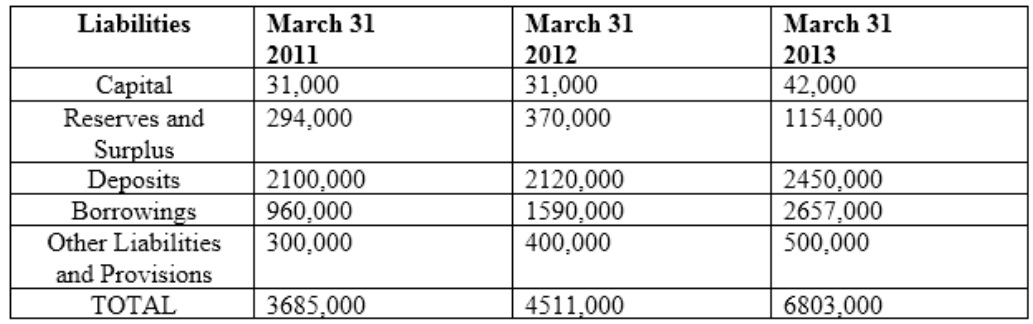
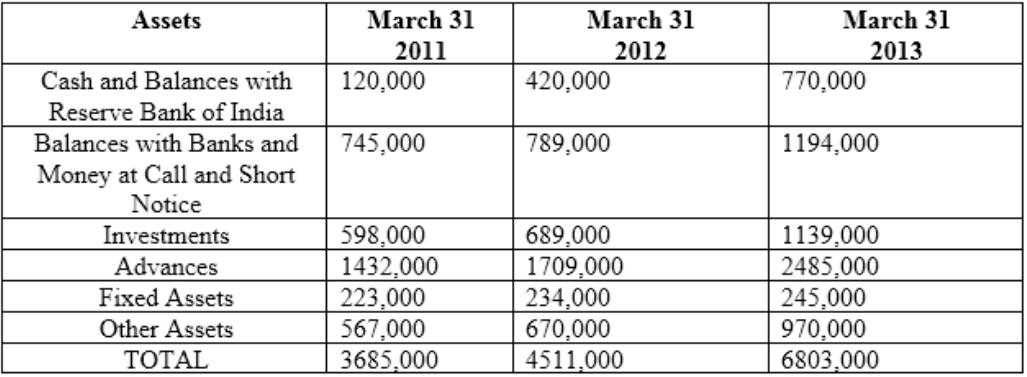
Balance Sheet


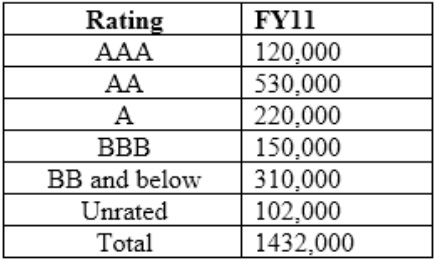
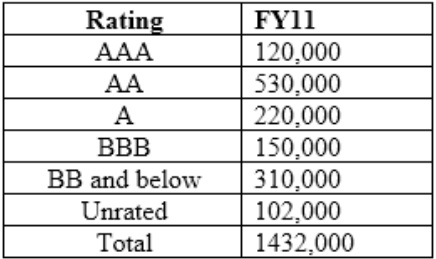
The rating wise break-up of assets for FY11 is as follows:

Cost to income ratio is best for which year
Satish Dhawan, a veteran fixed income trader is conducting interviews for the post of a junior fixed income trader. He interviewed four candidates Adam, Balkrishnan, Catherine and Deepak and following are the answers to his questions.
Question 1: Tell something about Option Adjusted Spread
Adam: OAS is applicable only to bond which do not have any options attached to it. It is for the plain bonds.
Balkishna: In bonds with embedded options, AS reflects not only the credit risk but also reflects prepayment risk over and above the benchmark.
Catherine: Sincespreads are calculated to know the level of credit risk in the bound, OAS is difference between in the Z spread and price of a call option for a callable bond.
Deepark: For callable bond OAS will be lower than Z Spread.
Question 2: This is a spread that must be added to the benchmark zero rate curve in a parallel shift so that the sum of the risky bond's discounted cash flows equals its current market price. Which Spread I am talkingabout?
Adam: Z Spread
Balkrishna: Nominal Spread
Catherine: Option Adjusted Spread
Deepark: Asset Swap Spread
Question 3: What do you know about Interpolated spread and yield spread?
Adam: Yield spread is the difference between the YTM of a risky bond and the YTM of an on-the-run treasury benchmark bond whose maturity is closest, but not identical to that of risky bond. Interpolated spread is the spread between the YTM of risky bond and the YTM of same maturity treasury benchmark, which is interpolated from the two nearest on-the-run treasury securities.
Balkrishna: Interpolated spread is preferred to yield spread because the latter has the maturity mismatch, which leads to error if the yield curve is not flat and the benchmark security changes over time, leading to inconsistency.
Catherine: Interpolated spread takes account the shape of the benchmark yield curve and therefore better
than yield spread.
Deepak: Both Interpolated Spread and Yield Spread rely on YTM which suffers from drawbacks and inconsistencies such as the assumption of flat yield curve and reinvestment at YTM itself.
Then Satish gave following information related to the benchmark YTMs:

There is a 10.25% risky bond with a maturity of 4.75 year(s). Its current price is INR105.31, which corresponds
to YTM of 9.22%. Compute Interpolated Spread from the information provided in the vignette:
Following is information related banks:
Auckland Ltd is a public sector bank operating with about 120 branches across Indi
a. The bank has been in business since 1971 and has about 40% branches in rural areas and about 75% of all branches are in
Western India. On the basis of the size, Auckland Ltd will be ranked at number 31 amongst 40 banks in India.
Although top management has appointment period of 5 years, generally they retire on ach sieving age of 60 years with an average tenure of only 2 years at the top job.
Profit and Loss Account

Balance Sheet

The rating wise break-up of assets for FY11 is as follows:

Computer risk weighted assets for Auckland Ltd for FY11:
Security & Privacy
Satisfied Customers
Committed Service
Money Back Guranteed